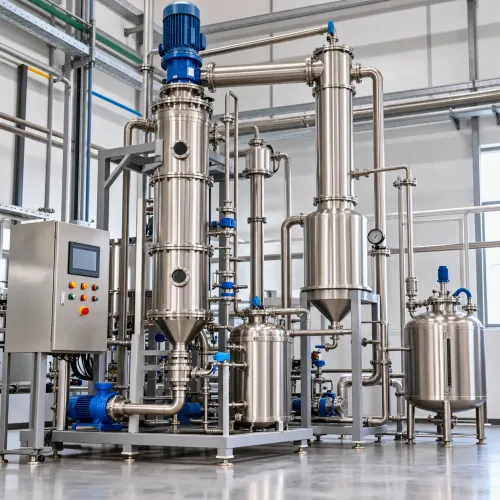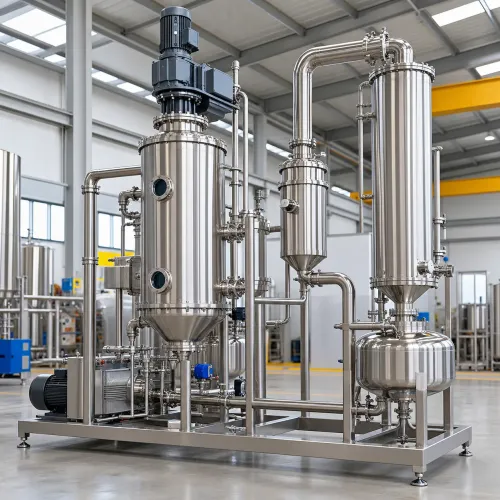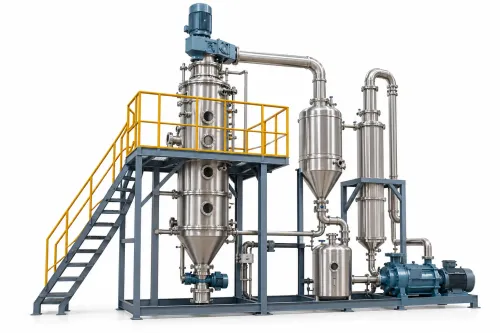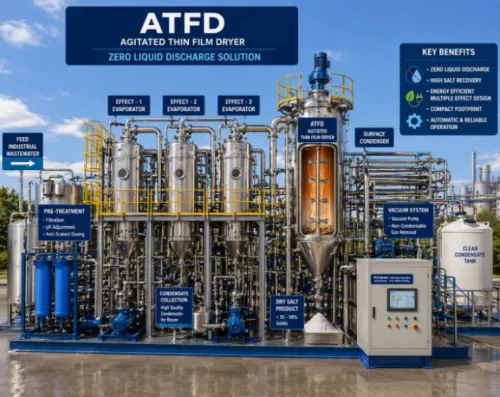
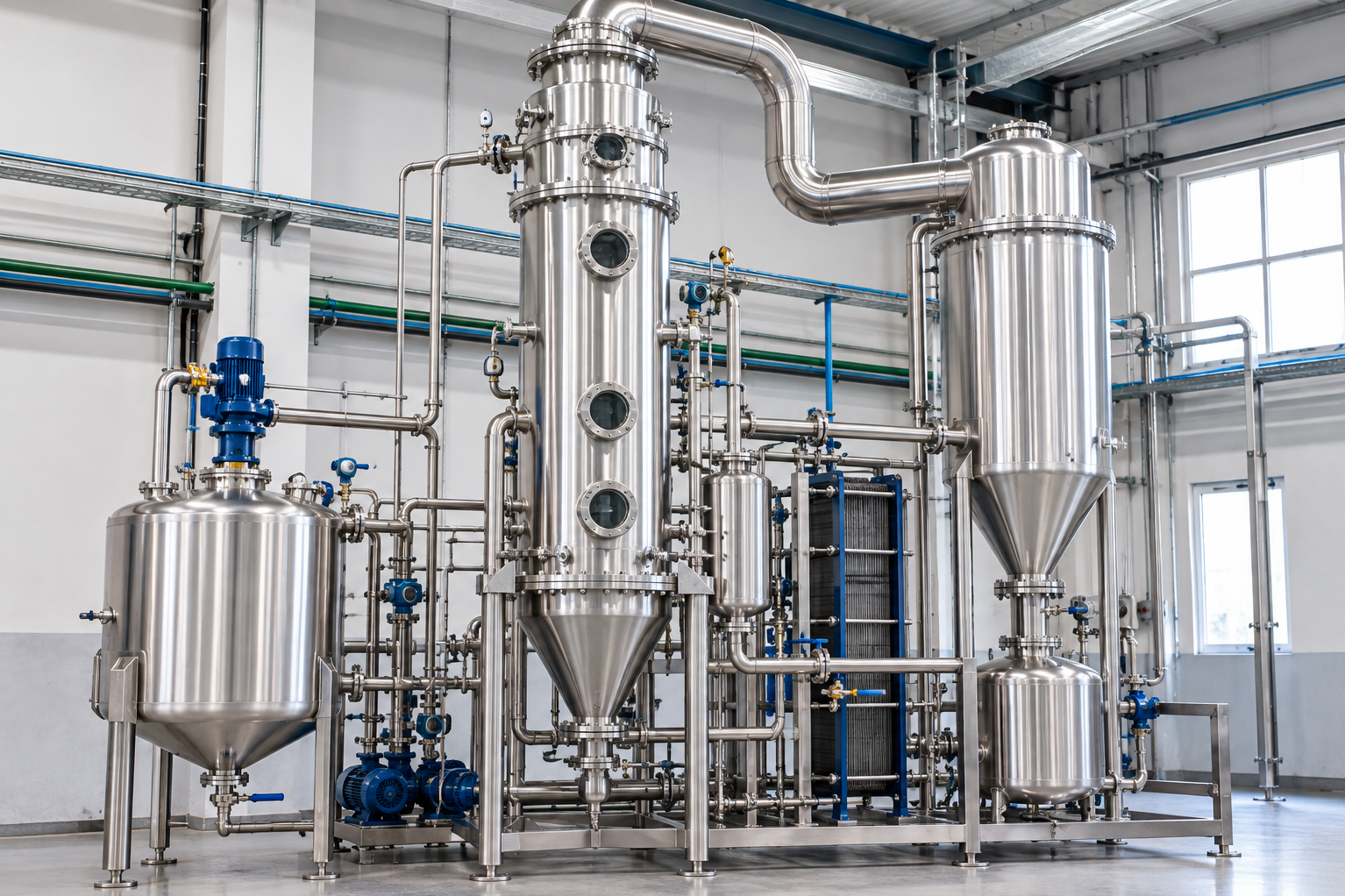
A falling film evaporator can deliver efficient continuous concentration with low liquid inventory and relatively short residence time. It is widely considered for heat-sensitive products and high-capacity evaporation duties, but performance depends heavily on liquid distribution and wetting of the heat-transfer surface.
Before purchasing a falling film evaporator in Vadodara, buyers should determine whether the feed can maintain a stable film under the expected operating conditions.
How the Falling Film Develops
Feed enters at the top of a vertical tube bundle and is distributed across the tube openings. Gravity draws the liquid downward as a film along the tube walls. Vapour forms during this movement and travels with or separately from the liquid, depending on the configuration.
The vapour and concentrated product are separated at the outlet. The product may pass to another effect, recirculate or leave the system at its required concentration.
Good performance begins with uniform feed distribution. Dry patches reduce effective heat-transfer area and may cause localised fouling or overheating.
When the Technology Is Suitable
Falling film evaporators are often appropriate when the liquid:
- Has low to moderate viscosity
- Can wet the tubes uniformly
- Is sensitive to prolonged heating
- Requires continuous processing
- Has manageable scaling behaviour
- Does not contain excessive suspended solids
- Can be distributed at the available flow rate
Recirculation can support wetting at lower feed rates, but it increases pumping and may extend product exposure.
Highly viscous, crystallising or heavily fouling liquids may be better handled by forced-circulation or mechanically agitated equipment.
Evaluate the Distributor Design
The distributor is one of the most important parts of the evaporator. It must divide the feed consistently across the tubes despite changes in flow, pressure and operating conditions.
Buyers should ask:
- What minimum flow is required for complete wetting?
- How is flow distributed across the tube sheet?
- Can the distributor be inspected and cleaned?
- How does the design handle turndown?
- Is recirculation required?
- What happens if some openings become blocked?
A large heat-transfer area offers little benefit if a portion of the tubes remains poorly wetted.
Consider Product Residence Time
Low residence time is a common advantage of falling-film operation. However, actual exposure depends on feed arrangement, recirculation, number of passes and system holdup.
For temperature-sensitive products, define both the maximum acceptable temperature and exposure duration. The control system should prevent overheating during start-up, low-feed conditions and shutdown.
Vacuum operation can further reduce boiling temperature.
Understand Fouling Risk
Deposits may form from salts, proteins, polymers, suspended matter or thermally degraded product. Even a thin layer can reduce heat transfer and disturb film flow.
The engineering review should consider tube diameter, length, velocity, surface finish and cleaning method. A cleaning-in-place cycle may use water, alkaline solution, acid or another compatible cleaning agent depending on the deposit.
The required cleaning frequency should be included in production-capacity planning.
Compare Utility and Performance Data
A useful quotation should provide:
- Feed and product conditions
- Evaporation rate
- Steam consumption
- Cooling-water requirement
- Electrical load
- Operating pressure
- Heat-transfer area
- Construction materials
- Turndown range
- Condensate characteristics
If the evaporator is part of an MEE, the proposal should include an overall heat and mass balance for every effect.
Procurement Support for Gujarat Plants
Vadodara and surrounding industrial regions contain chemical, pharmaceutical, food and speciality manufacturing operations that can benefit from continuous evaporation. Actual steam pressure, seasonal cooling-water temperature and available plant height should be confirmed during design.
Chemie Prozessors manufactures evaporation systems and can assess equipment configuration, utility integration and material compatibility for the intended duty.
A falling film evaporator in Vadodara is a sound investment when the feed remains distributable and the plant values continuous processing with controlled thermal exposure. Careful evaluation of the distributor, fouling risk and operating range helps ensure that predicted capacity remains achievable in daily production.
Keywords