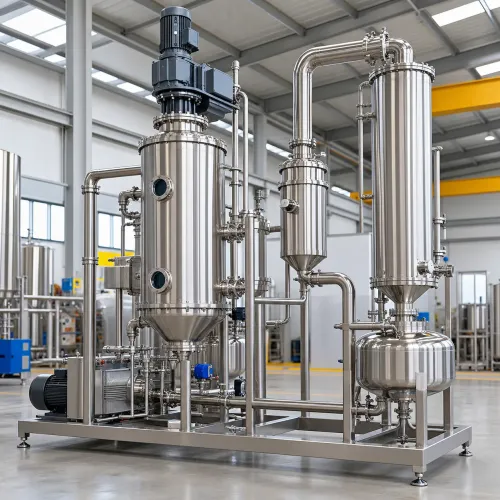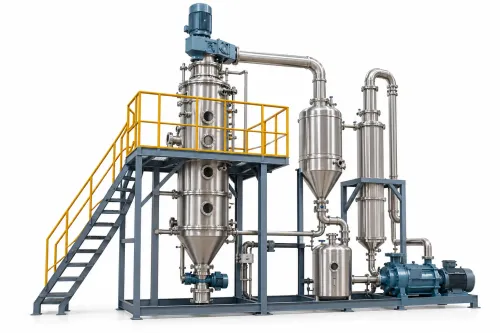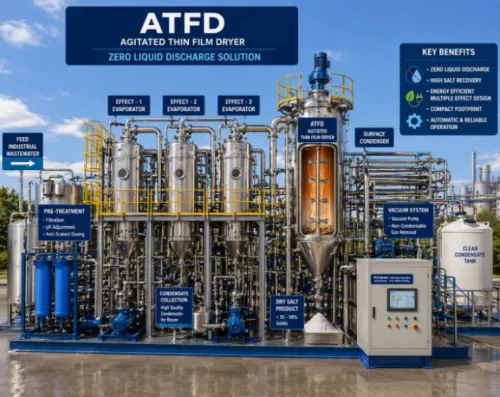
Conventional evaporators depend on predictable liquid circulation and stable heat transfer. When a product becomes highly viscous or degrades during extended heating, those assumptions may no longer hold. A wiped film evaporator addresses this challenge by mechanically creating a thin, continuously renewed liquid film on a heated surface.
This combination of thin-film processing, vacuum operation and short exposure time makes the equipment valuable for selected chemical and pharmaceutical duties.
How Wiped Film Evaporation Works
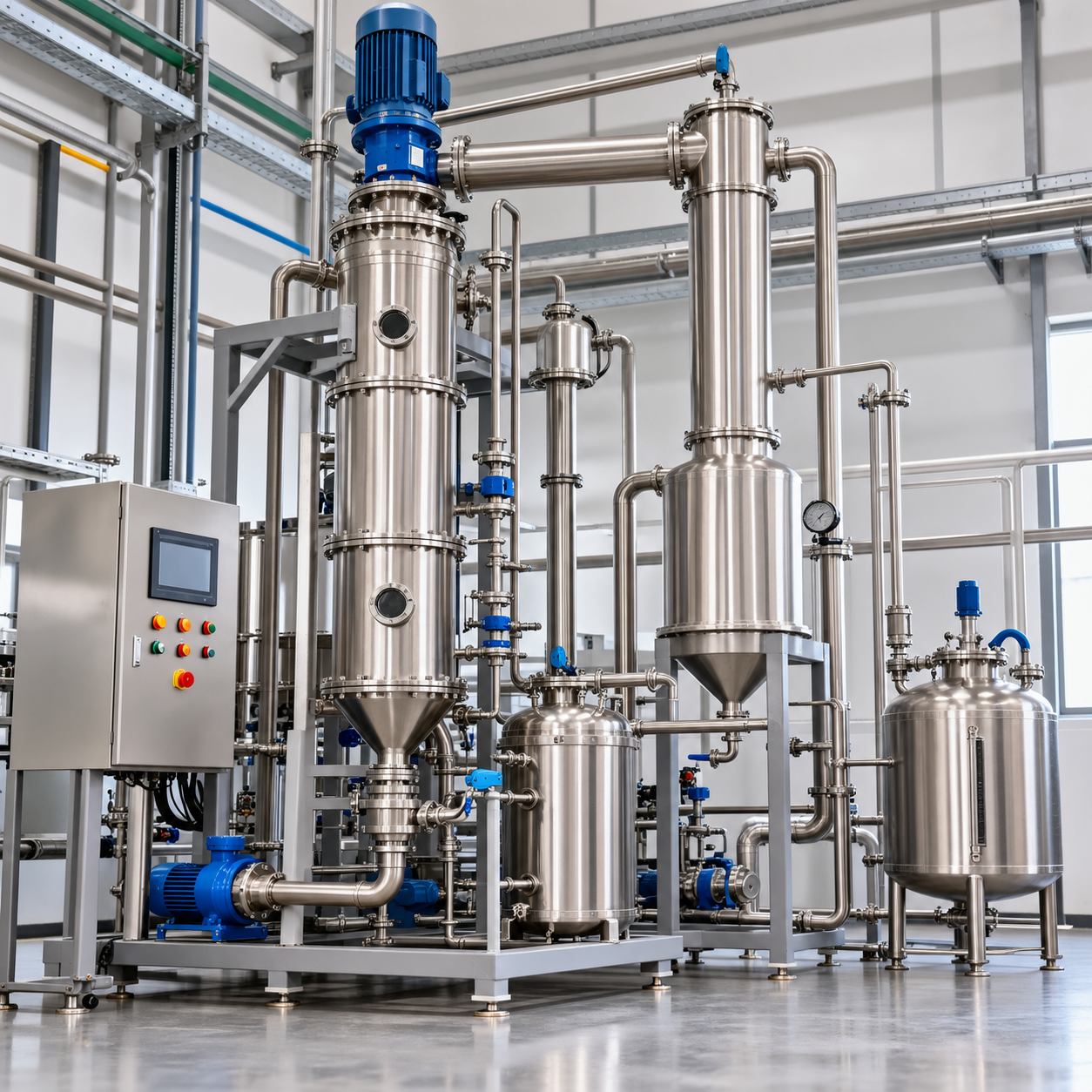
Feed enters the evaporator and is distributed over the inner surface of a heated body. A rotating assembly fitted with wipers spreads and agitates the material.
Heat passes through the wall into the thin film, causing volatile components to evaporate. Vapour travels to a condenser or further separation equipment, while the concentrated product moves toward the outlet.
Because only a relatively small quantity of material is present on the heated surface at a given time, residence time can be shorter than in systems with large boiling inventories.
Benefits for Viscous Products
Viscosity often rises as solvent is removed. In a natural-circulation or falling-film unit, this may weaken circulation or prevent uniform film distribution.
Mechanical wiping maintains movement at the heat-transfer surface. It can also reduce the thickness of the stagnant boundary layer that limits heat transfer.
This does not mean every viscous material can be processed without testing. Extremely sticky, elastic or solidifying products may require a specialised rotor, controlled feed temperature or staged concentration.
Benefits for Heat-Sensitive Materials
Vacuum allows evaporation at a reduced boiling temperature. Short residence time further limits the duration of thermal exposure.
These characteristics can help protect product colour, composition and functionality. Potential applications include pharmaceutical intermediates, speciality chemicals, oils, extracts, resins and other high-value materials.
The appropriate product-temperature limit should be established from process knowledge or laboratory testing. Heating-medium temperature alone does not represent the material’s complete thermal history.
Solvent Recovery Considerations
In solvent-removal service, the evaporated component is condensed and collected. Recovery performance depends on vapour-liquid separation, condenser temperature, vacuum level and the solvent’s physical properties.
The system may require multiple condensers or a cold trap for low-boiling solvents. Receiver design, inert-gas provisions and hazardous-area classification should be considered where flammable vapours are present.
Product entrainment must be limited to protect solvent purity and yield.
Operational Variables to Monitor
Stable wiped film evaporation depends on coordinated control of:
- Feed rate
- Feed temperature
- Rotor speed
- Heating-medium temperature
- Operating pressure
- Condenser temperature
- Product outlet condition
- Motor current or torque
Changing one variable can influence several others. For example, excessive feed rate may increase film thickness, reduce final concentration and overload the condenser.
Operators should be trained to recognise trends rather than relying only on isolated readings.
Cleaning and Product Changeover
For multiproduct chemical or pharmaceutical facilities, cleaning requirements can affect available production time. The evaporator should include suitable drainability, cleaning connections and access for inspection.
Cleaning procedures must be compatible with seals, wipers and construction materials. If a product hardens when cooled, the shutdown sequence should prevent material from remaining inside the equipment.
Changeover validation may also be required where cross-contamination presents a quality risk.
Engineering Support in Vadodara
Vadodara’s process industries manufacture diverse chemicals, intermediates and pharmaceutical products. These applications frequently require customised operating pressures, materials and auxiliary systems.
Chemie Prozessors can evaluate the liquid’s concentration profile, viscosity, thermal sensitivity and solvent characteristics when developing a wiped-film solution. Pilot or feasibility trials are particularly useful when product behaviour is not fully documented.
A wiped film evaporator in Vadodara should be chosen for a clearly defined processing advantage. When applied to the correct duty, it can combine controlled heating, short residence time and dependable handling of materials that are difficult to concentrate using conventional equipment.
Keywords