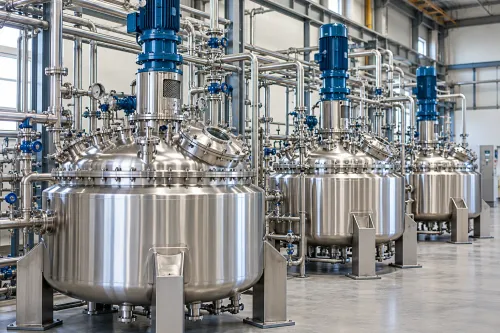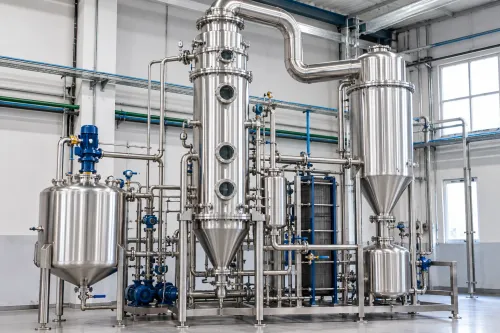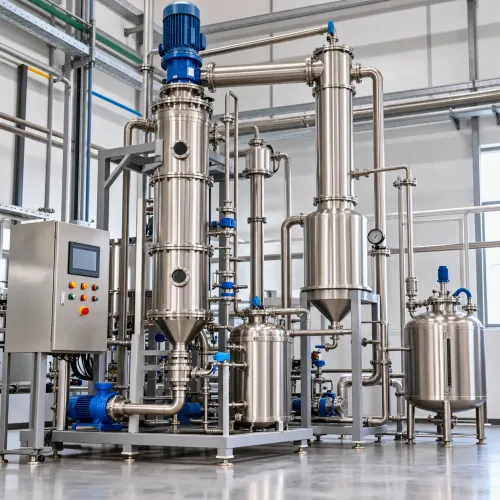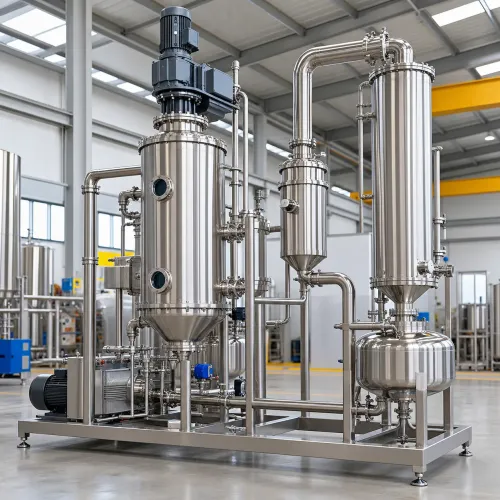
Steam is a major operating expense in many concentration processes. A multiple effect evaporator addresses this issue by reusing vapour energy through a sequence of evaporation stages. The technology can improve thermal efficiency, but its performance depends on feed behaviour, available temperature difference and correct system integration.
For chemical and pharmaceutical facilities in Vadodara, understanding these fundamentals is important before deciding whether an MEE is suitable.
How the Effects Work Together
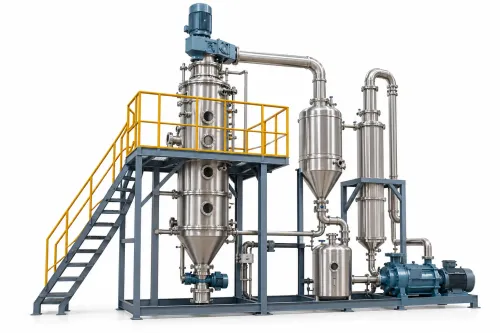
In the first effect, steam transfers heat to the feed and evaporates part of the volatile component, usually water. The vapour leaving this stage is directed to the heating side of the next effect.
Each subsequent effect operates at a lower pressure. Because the boiling point falls with pressure, vapour from the earlier stage can provide useful heating even though its temperature is lower than that of the original steam.
This sequence can continue through several effects before the final vapour is condensed.
What Steam Economy Means
Steam economy describes how much solvent or water is evaporated per unit of fresh steam supplied. A multi-effect system generally achieves better steam economy than a single-effect evaporator because it reuses vapour energy.
Actual performance will not equal a simple theoretical multiple of the number of effects. Heat losses, condensate conditions, boiling-point elevation, fouling and available temperature driving force all influence results.
Procurement decisions should therefore use a documented heat and mass balance rather than a general efficiency claim.
Why Boiling-Point Elevation Matters
A solution containing dissolved substances often boils at a higher temperature than pure water at the same pressure. This difference is known as boiling-point elevation.
As concentration increases, boiling-point elevation may become more significant. It consumes part of the temperature difference needed for heat transfer and can limit the number of practical effects.
This is especially important for high-salt effluents and concentrated chemical solutions. Ignoring it may produce an MEE that performs below its expected evaporation rate.
Common Flow Arrangements
Feed can move through a multiple-effect evaporator in different patterns.
In forward-feed operation, the liquid generally travels in the same direction as the vapour sequence. It may require less inter-effect pumping and can suit feeds entering at a relatively high temperature.
Backward-feed operation moves liquid toward the hotter effects. This arrangement can provide advantages for products that become viscous at higher concentration because the most concentrated liquid encounters higher temperature. However, additional pumping may be needed.
Mixed and parallel-feed arrangements are also possible for specialised duties. The correct choice depends on thermal sensitivity, viscosity, solids behaviour and energy integration.
Where MEE Systems Are Used
Multiple-effect evaporation can support:
- Chemical solution concentration
- Pharmaceutical process streams
- Food and ingredient concentration
- Effluent volume reduction
- Salt-bearing wastewater treatment
- Solvent or water recovery
- Feed preparation for crystallisers
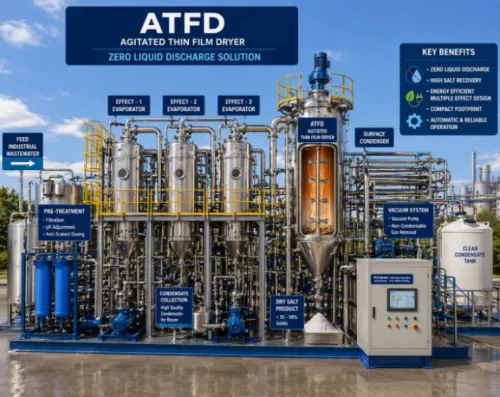
- Pre-concentration before an ATFD
In a wastewater application, the MEE is usually one part of a broader treatment sequence. Pretreatment, biological treatment, membrane processes, softening or filtration may be needed before evaporation.
Operational Factors That Influence Results
Stable feed composition makes an MEE easier to operate. Sudden changes in dissolved solids, suspended matter, pH or organic load can cause foaming, entrainment and fouling.
Operators should monitor effect temperatures, vapour pressures, feed rate, recirculation flow, condensate quality and product concentration. A gradual decline in temperature difference or capacity may indicate scaling.
Correct antifoam dosing, scheduled cleaning and instrument calibration can protect system performance.
Relevance to Vadodara’s Process Industries
Vadodara has a strong base of chemical, pharmaceutical and engineering activity, with access to major industrial centres across Gujarat. Facilities in this region often need customised solutions because process streams vary considerably between products and campaigns.
Chemie Prozessors develops evaporation equipment using application data such as feed composition, capacity, concentration target and site utilities. This engineering approach is important when an MEE must connect with existing tanks, treatment systems or downstream dryers.
A multiple effect evaporator in Vadodara should be specified according to realistic operating conditions. When the feed is properly characterised and the effects are thermally balanced, the system can reduce steam demand while delivering dependable concentration performance.
Keywords