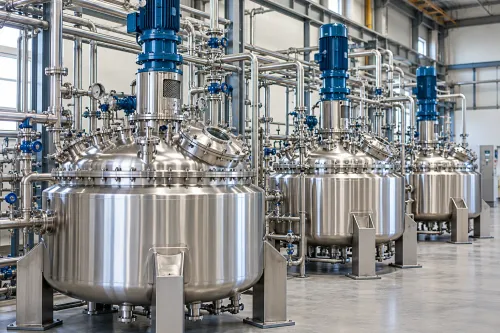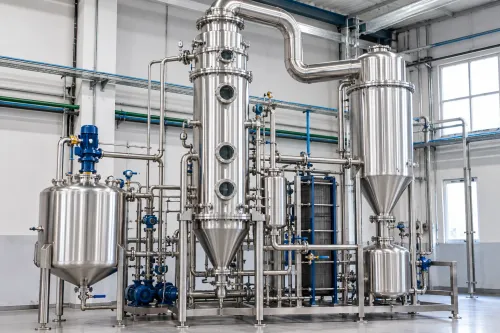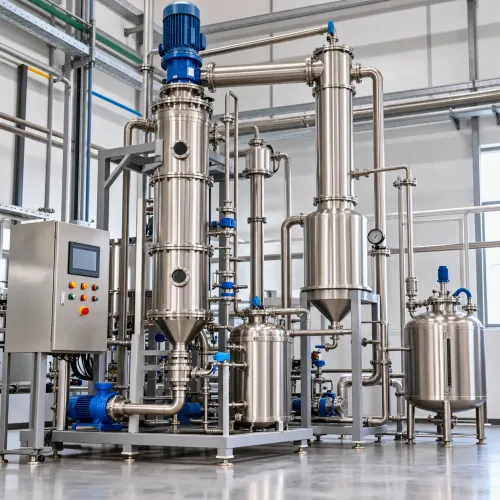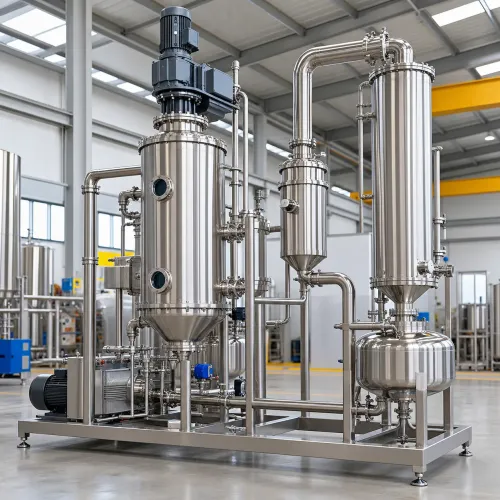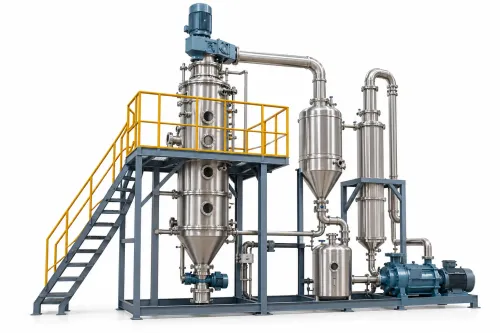
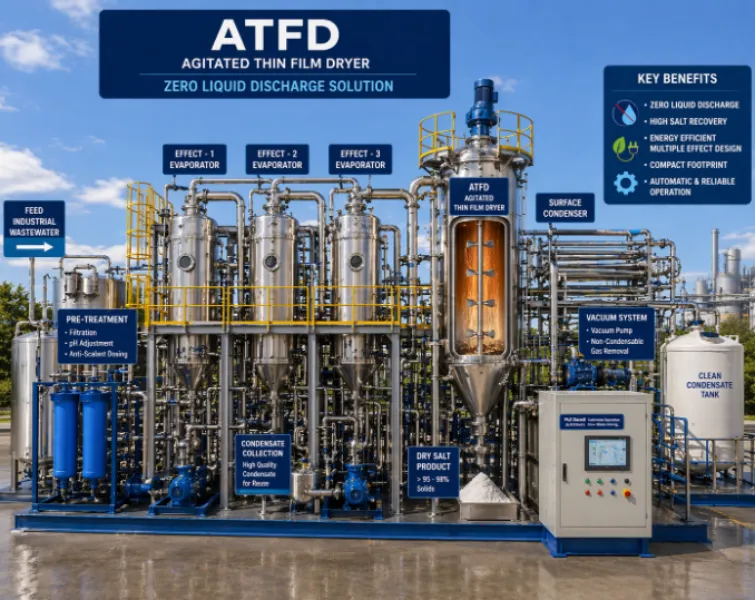
An agitated thin film dryer is often installed near the final stage of a zero liquid discharge system. Its duty is demanding: receive concentrated slurry or viscous liquid, evaporate the remaining moisture and discharge a solid or semi-solid residue.
Because the feed is already highly concentrated, small variations in viscosity, salt composition or moisture can materially affect dryer performance. A disciplined technical evaluation is therefore essential when selecting an ATFD manufacturer in Vadodara.
Confirm the Purpose of the ATFD
The first question is what the equipment must achieve. Some plants need a free-flowing powder, while others can manage flakes, granules or a damp solid. The required outlet condition influences heat-transfer area, rotor arrangement, residence time and discharge system.
The downstream handling method should also be defined. Manual bagging, screw conveying, sealed collection and hazardous-waste storage create different layout and containment requirements.
Provide Representative Feed Data
Average values alone are rarely sufficient. The manufacturer should receive both normal and maximum conditions for:
- Feed rate
- Total solids
- Moisture content
- Density
- Viscosity
- Salt composition
- Organic content
- Feed temperature
- Foaming tendency
- Corrosion characteristics
A slurry from an MEE may behave differently during plant start-up, steady operation and cleaning. The proposed ATFD should tolerate a practical operating range.
Ask for Trial or Feasibility Evidence
Drying behaviour cannot always be predicted accurately from chemical analysis. Some salts form a dry powder, while others become sticky, glassy or hygroscopic. Organic matter may char at elevated surface temperatures, and mixed salts may have complex phase behaviour.
Pilot testing can reveal:
- Achievable outlet moisture
- Deposit formation
- Product discharge characteristics
- Required wall temperature
- Rotor power demand
- Vapour quality
- Cleaning requirements
- Likely throughput range
Test conditions should resemble the proposed industrial duty as closely as possible.
Review Rotor and Blade Design
Inside an ATFD, rotating blades spread and agitate the feed over a heated surface. This creates a thin, renewed layer that supports heat and mass transfer.
Blade clearance, rotor speed, mechanical rigidity and deposit-scraping behaviour all influence operation. The drive must handle normal torque as well as reasonable process fluctuations.
Ask how the design responds to temporary over-concentration, solids accumulation or a change in feed rate. Torque monitoring and protective interlocks can help prevent mechanical damage.
Examine Construction Materials
Concentrated salts can be more corrosive than the original wastewater. Material selection should account for chlorides, operating temperature, pH, cleaning chemicals and possible acidic or alkaline constituents.
The shell, rotor, blades, product-contact piping and seals may not all require the same material, but every wetted component should be reviewed. Surface finish and fabrication quality can also affect product sticking and cleanability.
Assess Vapour and Condensate Management
Moisture removed by the dryer leaves as vapour and must be condensed or treated. The vapour may contain volatile organics, ammonia or entrained droplets depending on the feed.
The proposal should clearly define condenser duty, vacuum requirements, condensate collection and any necessary polishing. Vapour handling should be included in the mass balance rather than treated as an unspecified external utility.
Check Safety and Maintenance Access
Maintenance personnel need safe access to bearings, seals, drive components, inspection points and discharge arrangements. The design should support cleaning without excessive dismantling.
Useful provisions may include:
- Torque and motor-current monitoring
- Temperature and pressure instruments
- Low-flow and high-temperature interlocks
- Vacuum-loss protection
- Insulation and guarding
- Accessible cleaning connections
- Suitable platforms and lifting arrangements
Hazardous-area requirements should be identified before electrical equipment is selected.
Evaluate Local Project Readiness
For facilities in Vadodara and nearby Gujarat industrial estates, site layout, utility availability and integration with the existing MEE require early review. A local site assessment can reveal elevation, piping and maintenance-clearance constraints that drawings alone may miss.
Chemie Prozessors manufactures evaporation and thin-film processing equipment for industrial applications. A productive enquiry should include process data, expected operating schedule, desired solids form and available utilities.
The right ATFD manufacturer in Vadodara should demonstrate how the proposed equipment will handle the actual concentrate. A strong selection decision rests on feed testing, transparent calculations, appropriate metallurgy and a clear plan for vapour, solids and maintenance management.
Keywords