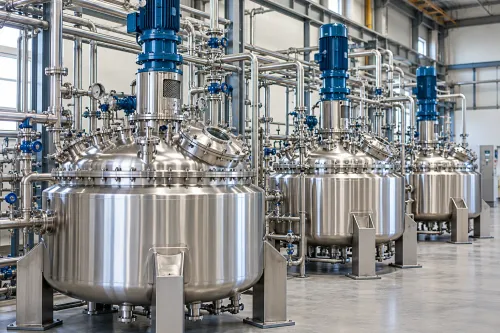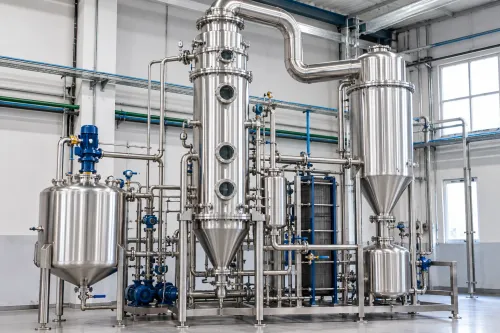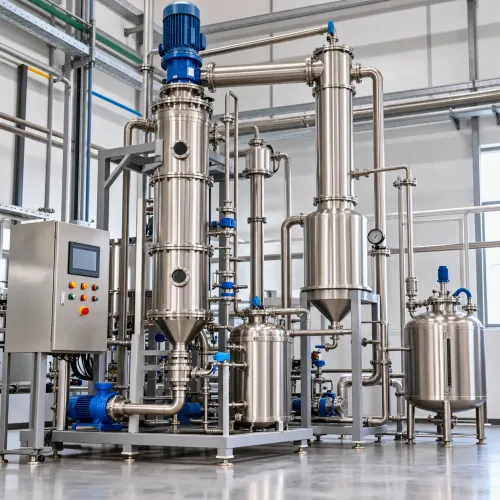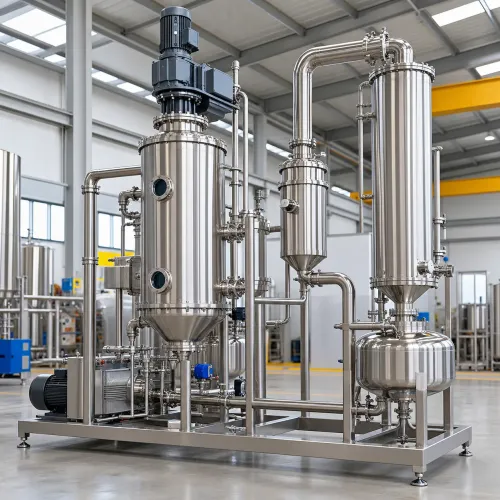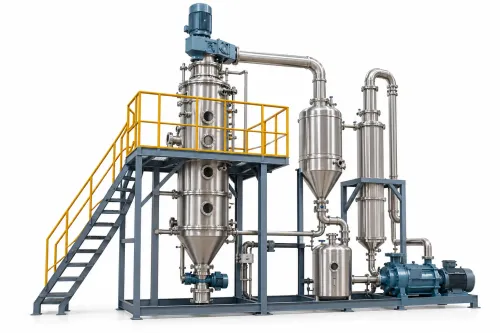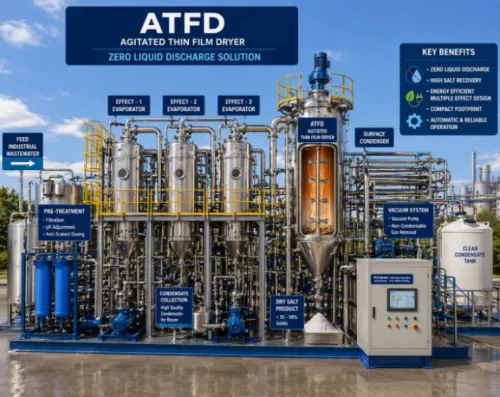
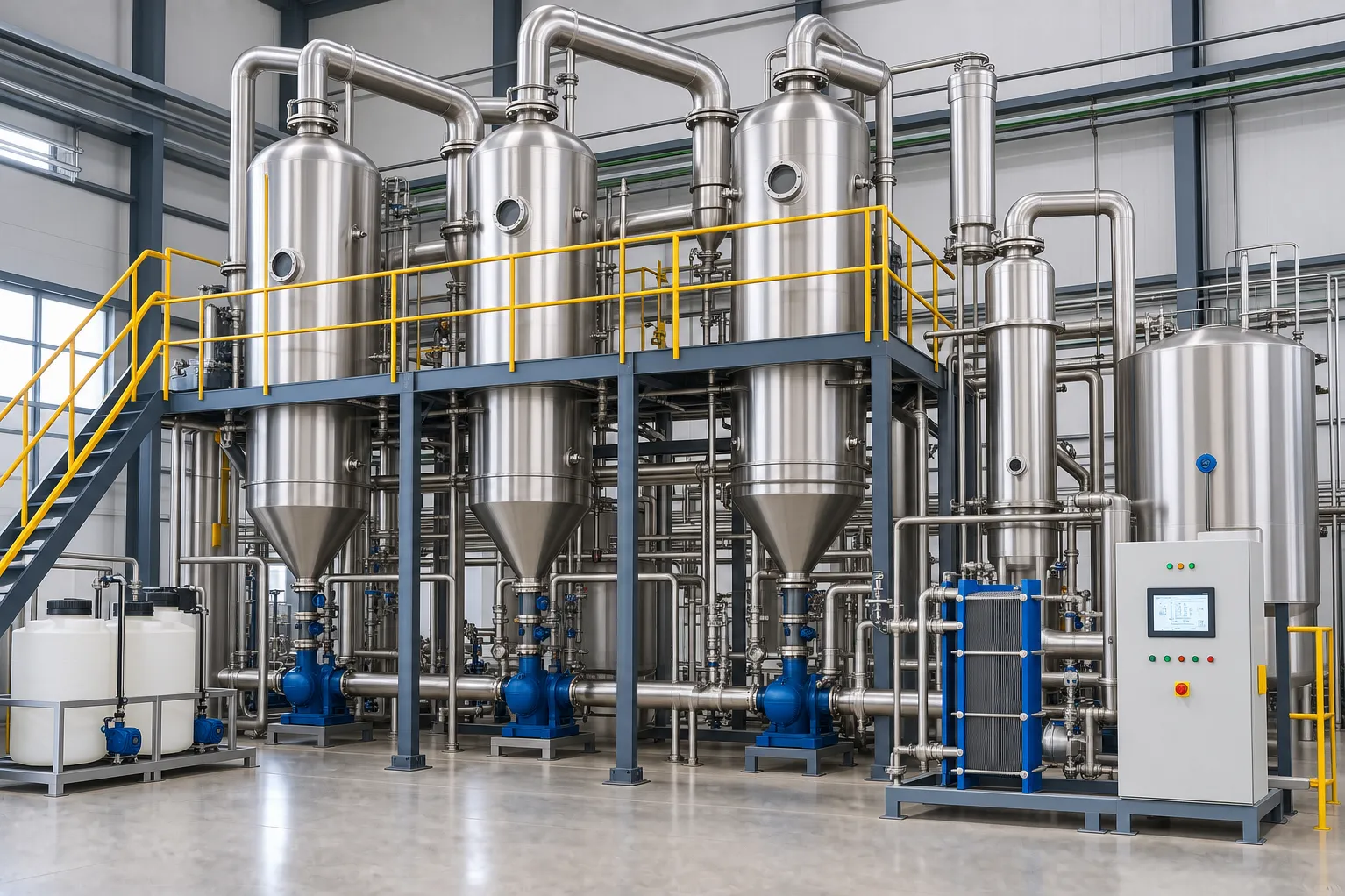
Industrial facilities often need to concentrate process liquids, recover water, reduce effluent volume, or prepare concentrated streams for further drying. A multiple-effect evaporation plant can perform these duties with substantially better steam economy than a basic single-effect arrangement when the feed characteristics and operating conditions are suitable.
Understanding how an MEE plant works helps plant managers and process engineers evaluate whether the technology fits their production or wastewater-treatment requirements.
What Is a Multiple-Effect Evaporation Plant?
A multiple-effect evaporator consists of two or more evaporation stages connected in sequence. The vapour produced in one effect becomes the heating medium for the next effect, which operates at a lower pressure and boiling temperature.
This reuse of thermal energy is the central advantage of the system. Instead of supplying fresh steam independently to every stage, the plant extracts additional evaporation duty from vapour that would otherwise need to be condensed.
The appropriate number of effects is determined by factors such as:
- Required evaporation capacity
- Available steam pressure
- Cooling-water conditions
- Feed boiling-point elevation
- Product temperature sensitivity
- Desired concentration
- Capital and operating-cost balance
Adding more effects may improve steam economy, but it also increases equipment, control and maintenance requirements. More effects are therefore not automatically better.
Feed Characteristics Determine the Design
An MEE plant cannot be selected from flow rate alone. The manufacturer needs reliable information about the liquid entering the system.
Important properties include total dissolved solids, suspended matter, viscosity, density, foaming tendency, scaling potential, corrosiveness and boiling-point elevation. These characteristics can change considerably as the liquid becomes concentrated.
A feed that flows easily at low concentration may become highly viscous near the target outlet concentration. Similarly, dissolved salts may remain stable in the feed tank but precipitate on heat-transfer surfaces during evaporation.
Representative laboratory analysis and, where necessary, pilot trials can reduce uncertainty before detailed engineering begins.
Why Vacuum Operation Is Common
Many multiple-effect evaporators operate under vacuum. Lowering the operating pressure reduces the liquid’s boiling temperature, which can provide several benefits.
It may protect temperature-sensitive products, reduce the risk of thermal degradation and make it possible to use lower-grade vapour in subsequent effects. Vacuum operation can also help establish the required temperature difference across the effects.
The vacuum system must be engineered as part of the complete plant. Air leakage, inadequate condenser performance or incorrect vacuum-pump sizing can affect capacity throughout the evaporation train.
Heat Transfer Must Remain Stable
Evaporation performance depends heavily on clean and effective heat-transfer surfaces. Scaling, crystallisation and product deposition create resistance between the heating medium and process liquid. As deposits grow, evaporation capacity may fall while steam consumption rises.
A suitable design considers:
- Liquid velocity across heating surfaces
- Residence time
- Recirculation requirements
- Tube dimensions
- Vapour-liquid separation
- Cleaning access
- Material compatibility
- Expected fouling rate
The operating team also needs a practical cleaning-in-place procedure. Designing for nominal capacity without considering cleaning frequency can result in unstable long-term production.
Local Engineering Considerations in Vadodara
Vadodara and the wider Gujarat industrial region support chemical, pharmaceutical, speciality chemical, dye, intermediate and related process industries. Plants in these sectors may have very different feed compositions even when their required evaporation capacities appear similar.
A local engineering discussion can help account for utility availability, site space, existing effluent-treatment infrastructure and integration with downstream equipment. Steam pressure, cooling-water temperature and electrical load should be confirmed using actual site conditions rather than assumed values.
Chemie Prozessors evaluates evaporation requirements from a process-system perspective, including feed behaviour, heat balance, construction materials and downstream concentration or drying needs.
Information Needed Before Engineering Begins
A useful technical enquiry should include:
- Feed flow rate and operating schedule
- Inlet and desired outlet concentration
- Chemical composition and pH
- Density and viscosity data
- Presence of suspended solids
- Scaling, foaming or corrosion concerns
- Available steam and cooling-water conditions
- Required condensate quality
- Space and height restrictions
- Applicable material or fabrication standards
These details allow an MEE plant manufacturer in Vadodara to develop a more realistic process proposal. A properly engineered system should deliver the required concentration while balancing steam economy, maintainability, product quality and dependable operation.
Keywords