High humidity and rain do not directly make process liquor harder to boil under a controlled vacuum, but they can reduce cooling capacity, destabilise vacuum and introduce water into the feed system. By the end, you will know which readings to trend, which inspections to complete and how to separate weather-related losses from fouling, foaming, blockage or instrument faults.
Key takeaways
- Inspect cooling-water temperature, flow and condenser approach before monsoon startup.
- Clean distribution nozzles and confirm even wetting across every tube.
- Compare vacuum, steam pressure and condensate temperature before changing process settings.
- Specify humidity allowances, weatherproof controls and cooling capacity for Vadodara conditions.
Why Vadodara’s monsoon changes evaporator performance
June through September rain changes falling-film evaporator performance mainly by changing the cooling-medium conditions, not by wetting the process liquor. High dew points, high wet-bulb temperatures, cloud cover and fluctuating ambient temperature reduce the margin available to reject vapour heat.
Under a controlled vacuum, falling film evaporation humidity has little direct effect on the liquor’s boiling point. Its indirect effects are more important: a cooling tower approaches a warmer wet bulb, a surface condenser receives warmer water, and an air-cooled condenser loses capacity.
Condenser pressure then rises, vacuum weakens, boiling temperature increases and evaporation rate falls.
Check these values instead of relying on relative humidity alone:
- Cooling-medium design inlet temperature and flow
- Entering-air wet-bulb temperature and cooling-tower approach
- Surface-condenser pressure and cooling-water outlet temperature
- Air-cooled condenser fan performance and coil cleanliness
Rainwater does not normally enter the sealed process side, but wet external surfaces can create trouble. If chilled-water lines, vacuum piping or instrument impulse lines fall below dew point, condensation forms; sealed vapour-barrier insulation works better than simply adding thickness.
Moisture also accelerates corrosion at supports and insulation terminations, while degraded cable glands, panel seals and shutdown condensation reduce electrical insulation resistance.
These evaporator weather conditions in Vadodara make vacuum pumps, cooling circuits and electrical panels the weather-sensitive parts of the system. Rising condenser pressure with warmer cooling water points to a cooling-side loss before it proves a heat-transfer-area fault.
The monsoon pre-start and shutdown checks operators should follow
Inspect before admitting steam; moisture faults can stop industrial evaporator monsoon operation before heat transfer becomes the problem. Use this sequence:
- Walk the roof, drains and rainwater paths. Find leaks, ponding and discharge toward the skid, then inspect exposed supports, support shoes, drain pockets and insulation terminations for corrosion.
- Check cable glands, junction boxes, transmitters, load cells and panel door gaskets. Test panel heaters, high-humidity or condensation alarms, earth continuity and insulation resistance with equipment isolated; compare readings with the recorded baseline and follow the manufacturer’s test voltage. Review motor and VFD fault history.
- Confirm steam-trap operation, open condensate paths, barometric legs, vacuum-pump condition, instrument-air dryer operation and cooling-water flow, temperature and tower approach to entering-air wet bulb.
- Screen the feed before charging. Verify tank levels and look for sudden dilution, low conductivity, reduced density or visible rainwater entry; do not compensate for diluted liquor by increasing steam blindly.
- Start circulation, establish distributor wetting across every tube, then stabilise steam pressure gradually. Confirm vacuum and separator pressure before increasing feed, and keep circulation continuous during ramp-up.
- For shutdown, isolate steam first, stop feed, maintain circulation long enough to clear liquor, and drain designated lines and vessels safely. Break vacuum through the specified dry-air path, not an open rain-exposed vent; keep panels warm, sealed and dry so humid air cannot condense inside.
How to hold capacity when cooling and film distribution become unstable
Warmer cooling water or reduced air-cooler capacity raises condenser pressure. Vacuum then weakens, boiling temperature rises, and the available temperature difference falls before the heating surface is fully used. Check condenser cleanliness, cooling-water flow, cooling-tower approach to entering-air wet bulb, air-cooler fans and non-condensable-gas removal.
Repair air leaks and keep insulation sealed with a continuous vapour barrier; wet insulation turns a small heat leak into external condensation and corrosion.
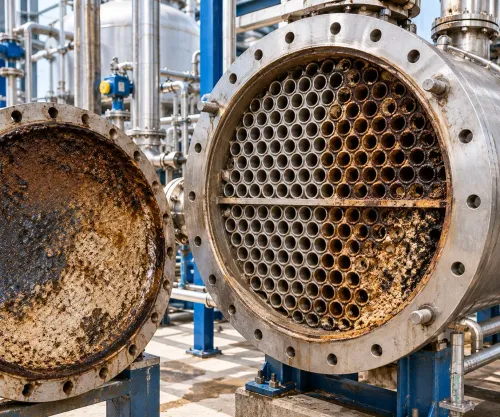
A falling film evaporator for during monsoon in Vadodara also loses capacity through poor wetting. Reduced feed flow, clogged distributor holes, blocked nozzles, higher viscosity, suspended solids or rainwater-diluted liquor can leave dry tube patches, local scale and hot spots while the total-flow indicator still looks normal.
| Condition | What changes | First check |
|---|---|---|
| Cooling side | Higher condenser pressure and weaker vacuum | Cooling-water temperature, flow, tower approach and condenser fouling |
| Feed distribution | Dry patches and hot spots | Distributor wetting, nozzle condition and actual feed flow |
| Liquor quality | Viscosity, boiling-point elevation and concentration shift | Density, conductivity or refractive index, tank level and solids |
| Falling film evaporation humidity | Indirect cooling, vacuum and corrosion effects | Condensation, air leakage and insulation condition |
Adjust steam pressure, feed rate or vacuum setpoint only after confirming continuous wetting and actual feed flow. Then verify concentration against density, conductivity or refractive index. If rainwater entered the tank, establish the new concentration before increasing steam; otherwise you can drive hot spots while chasing a false capacity loss.
Which readings reveal weather loss instead of a process fault
A rising condenser pressure with warmer cooling water points to monsoon cooling loss: vacuum weakens, vapour pressure and boiling temperature rise, and capacity falls before steam-side area is fully used.
Compare the trend with steam pressure, feed temperature, condensate temperature and separator pressure; do not blame humidity for a boiling-point rise inside a sealed vacuum system.
Use this sequence during industrial evaporator monsoon operation:
- Confirm total feed flow at the pump and distributor. Normal flow with poor tube wetting indicates blocked orifices, viscosity change or pump cavitation, not weather alone.
- Compare product density or total dissolved solids with feed temperature and steam pressure. A sudden density shift after rain indicates dilution or rainwater ingress; a gradual shift with stable inputs suggests scaling, foaming or entrainment.
- Check differential pressure across strainers, tubes, vapour paths and separators. A rising value identifies blockage; a sudden fall can indicate a bypass, broken path or incorrectly calibrated transmitter.
| Reading trend | Likely cause | Check next |
|---|---|---|
| Condenser pressure up, cooling water warmer, vacuum weaker | Monsoon cooling loss | Tower approach, flow and condenser cleanliness |
| Vacuum weak, separator pressure up, condensate warmer | Non-condensable-gas buildup | Air leaks and vent or ejector performance |
| Feed flow normal, density unstable, dry tube patches | Poor distribution, scaling or foaming | Distributor holes, viscosity and inspection |
| Differential pressure rising | Tube, screen or vapour-path blockage | Isolate and inspect the restricted path |
| Humidity alarm or insulation-resistance loss | Wet glands, condensation or panel seals | Dry cabinet, inspect glands and review motor/VFD faults |
Calibrate pressure, flow, density and temperature instruments against a traceable reference before assigning a process fault.
What to specify when preparing a falling-film unit for Vadodara weather
Specify a cooling tower against entering-air wet-bulb temperature, not dry-bulb temperature or relative humidity alone. For evaporator weather conditions in Vadodara, document the tower approach, condenser design margin and vacuum-system capacity at the June–September wet-bulb condition.
A falling film evaporator for during monsoon in Vadodara needs capacity checks for warmer cooling water, higher condenser pressure and weaker vacuum.
Purchase and retrofit specifications should include these physical protections:
- Separate rainwater from process drains, feed tanks and transfer lines; keep transfer areas covered, enclosed and self-draining.
- Provide removable access to feed screens and inspection access above distributors, so blocked openings and uneven wetting are not discovered only after capacity falls.
- Select enclosure ratings by IEC 60529 IP code for motors, junction boxes, transmitters, load cells and VFD panels. Add sealed cable glands, sloped canopies, sound door gaskets and panel pressurisation where required; specify cabinet heaters to prevent internal condensation.
- Protect carbon-steel support shoes, drain pockets, flange shields, insulation terminations and stainless-to-carbon-steel joints against trapped rainwater and galvanic corrosion.
| Item | Specify | Verify at commissioning |
|---|---|---|
| Cooling and vacuum | Wet-bulb case, condenser margin, vacuum capacity | Pressure and flow at design load |
| Access and drainage | Screen, distributor and drain inspection points | Open, clean and drain each path |
| Electrical protection | IP code, glands, heaters, pressurisation | Insulation resistance and humidity alarms |
| Baseline | Feed, steam, vacuum, condenser pressure, cooling-water temperatures, density and differential pressure | Record before and during monsoon |
Ask Chemie Prozessors, or any supplier, to submit these calculations, inspection points and commissioning tests rather than a generic evaporator specification.
Related products
 | Evaporator ₹1500000 Product Details: Material Stainless Steel Automation Grade Automatic Usage/Application Industrial Country of Origin Made in India Multiple Effect... |
 | ₹750000 Product Details: Capacity(kg) 150 Automation Grade Automatic Usage/Application Industrial Material Stainless Steel Power Source Steam / Thermic Fluid... View product → |
Frequently asked questions
Why does Vadodara’s monsoon affect falling-film evaporator performance?
High dew points, wet-bulb temperatures, cloud cover and changing ambient temperatures reduce the cooling system’s ability to reject vapour heat.
Which checks should operators complete before starting or shutting down during monsoon?
Inspect cooling-water flow and temperature, condenser surfaces, vacuum equipment, tube distributors, drains, electrical enclosures and moisture entry points.
How can operators hold evaporator capacity when cooling and film distribution become unstable?
Maintain adequate cooling flow, clean and level the distribution system, control feed rate and adjust operating conditions without starving the tubes.
Which readings distinguish weather-related capacity loss from a process fault?
Compare cooling-medium inlet and outlet temperatures, condenser approach, vacuum, steam pressure, feed rate, condensate temperature and differential pressure.
What should you specify for a falling-film evaporator used in Vadodara’s monsoon?
Specify design ambient conditions, humidity allowances, cooling capacity, weatherproof instrumentation, protected electrical panels, drainage and accessible inspection points.
Related product
 | ₹2000000 Our range of products include industrial zero liquid discharge system, multiple effect evaporators mee supplier in bharuch, zero liquid discharge... View product → |
Keywords