A reactor can discharge a wastewater stream that changes sharply between batches, while an MEE performs best with a steady, defined feed. By the end, you will know which reactor effluents belong in an evaporator, what pretreatment and feed data the design requires, and how to compare an MEE with other concentration and disposal routes.
Key takeaways
- Segregate reactor discharges before equalization, filtration, solvent separation and pH adjustment.
- Provide flow, solids, COD, chloride, pH and temperature data for evaporation design.
- Match evaporator materials to chlorides, solvents, acidity, alkalinity and operating temperature.
- Test condensate quality before reuse, discharge or return to the process.
How a Reactor Discharge Reaches the MEE
A reactor discharge reaches the MEE only after segregation at the outlet. Route the selected aqueous stream to an equalization or feed tank, then pass it through screening or filtration, oil removal, solvent separation and pH adjustment.
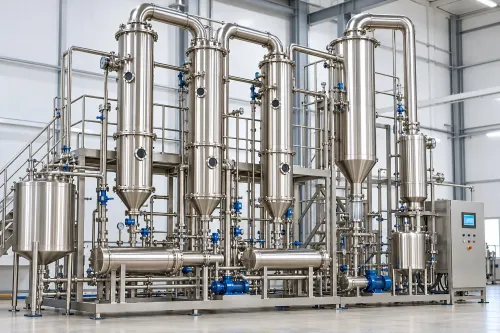
A controlled pump feeds the clarified liquor through the MEE effects; campaign peaks require tank volume rather than reliance on average daily flow.
| Stream | Feed decision | Required condition |
|---|---|---|
| Mother liquor | Suitable | Remove solids and confirm salt and corrosion limits |
| Spent wash | Suitable | Check COD, foaming and viscosity |
| Scrubber liquor | Suitable | Verify absorbed chemicals and adjust pH |
| Concentrated process wastewater | Suitable | Confirm boiling-point elevation and scaling tendency |
| RO reject | Suitable | Check chloride, sulfate and crystallisation behaviour |
| Oil, solvent-rich or polymer-forming drain | Divert | Separate or treat upstream; direct feeding causes fouling, foaming or hazardous vapour |
| Heavy-solids drain or incompatible acid/alkali | Divert | Neutralise, settle or treat before MEE entry |
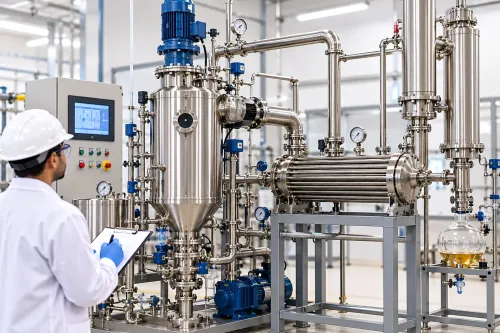
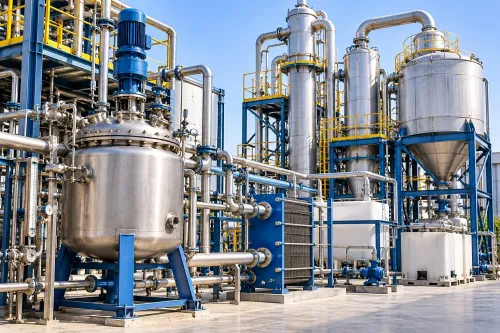
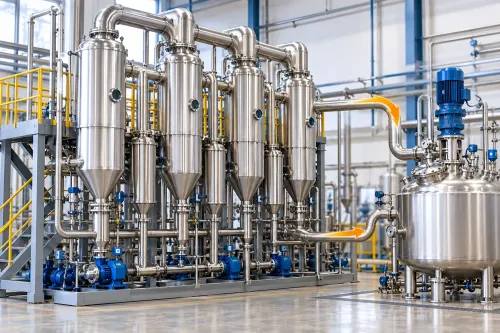
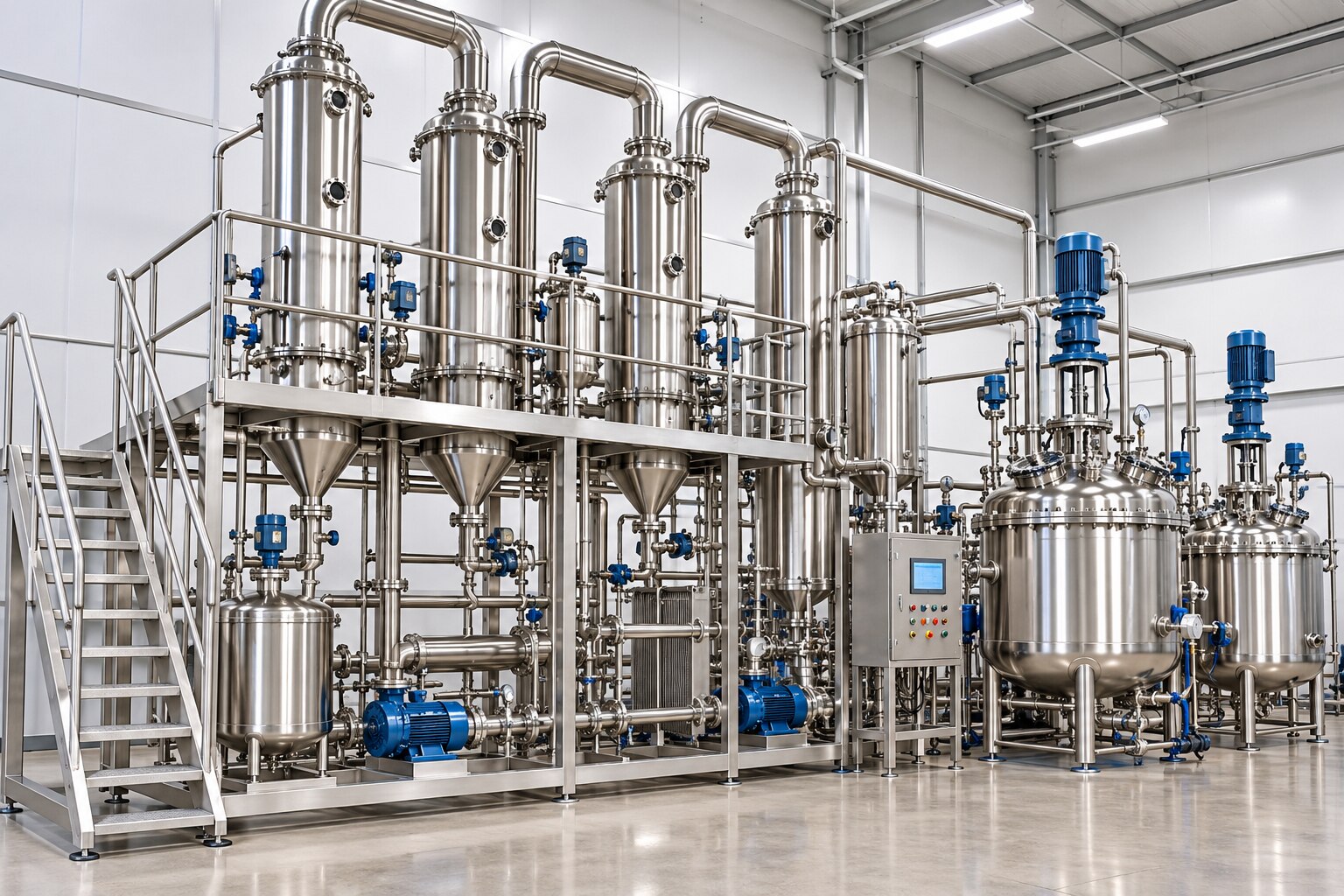
In MEE plant chemical reactor applications, vapour passes through a demister before condensation, while condensate collects in a separate tank for testing, reuse or polishing. The concentrated liquor leaves the final effect for further concentration, crystallisation, salt recovery, drying or authorised waste disposal.
An MEE plant for applications alongside chemical reactors in Vadodara removes water but leaves non-volatile salts and many organic contaminants in the concentrate. End-point handling is part of the process design, not an afterthought.
Pretreatment for Batch and Continuous Reactor Wastewater
Batch reactors need pretreatment sized for campaign peaks, not average daily flow. A two-hour discharge can carry far more COD, salt, solvent, heat or extreme pH than a continuous reactor stream. Equalization volume, an agitator and a controlled feed pump turn that shock into a steady MEE load.
1. Characterise each campaign, cleaning cycle and changeover. Record peak flow, suspended solids, conductivity, temperature, pH, TOC/COD, solvent concentration and foam tendency. Continuous service still needs capacity for sudden solids or pH changes.
2. Install screening or filtration, oil removal and neutralisation before the feed tank. Adjust pH within the evaporator’s feed envelope, dose antifoam only after confirming compatibility, and use chemical or biological COD treatment when emulsions, reactive organics or high COD interfere with boiling.
3. Interlock the feed pump to divert off-specification liquor when conductivity, temperature, foam, TOC/COD or solvent concentration exceeds its envelope. A diversion tank protects the evaporator and condensate system; sending an abnormal batch forward can contaminate both.
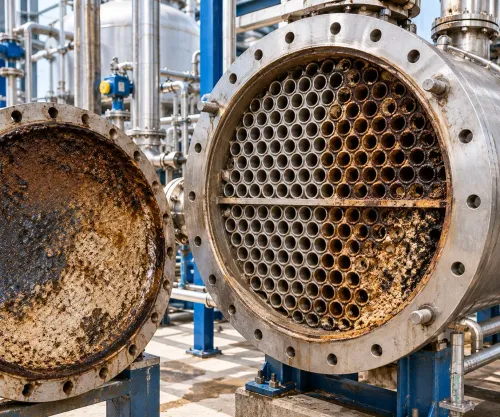
4. Schedule cleaning after defined campaigns and inspect during product changeovers. Remove deposits before they harden, then re-establish mixing and feed control. Lowering suspended solids alone does not stop dissolved scale: chlorides, sulfates and other dissolved salts can precipitate as concentration and boiling-point elevation rise.
These controls define reliable MEE plant chemical reactor applications and distinguish an MEE plant for chemical manufacturing from a simple water-reduction unit. The feed analysis, not the reactor label, determines pretreatment.
Feed Data, Evaporation Balance and Condensate Quality
Size and guarantee an MEE plant for chemical manufacturing against a defined feed envelope, not tonnes of water evaporated alone. For chemical reactors and evaporation systems in Vadodara, record:
- Flow in KLD, inlet and target total dissolved solids, temperature, pH, density, viscosity and boiling-point elevation.
- Suspended solids, COD or TOC, chloride, sulfate, solvent content and heat-sensitive components.
- Steam pressure, cooling-water temperature, minimum turndown, start-up time and required vacuum.
- Condensate quality, concentrate concentration, steam consumption and the test method used for acceptance.
A feed containing 1% dissolved solids concentrated to 20% gives an ideal liquid-volume reduction of about 20:1. That is before purge, residual moisture, scaling losses and operating constraints; boiling-point elevation also reduces temperature driving force and raises steam demand.
Evaporation rate does not prove condensate quality. Volatile solvents, ammonia, hydrogen sulfide, low-boiling organics and entrained droplets can cross into the vapour system, so specify demisters, vent condensation, condensate segregation, carbon treatment or further polishing. Do not assume condensate is reusable.
Close the balance by identifying crystallisation, solidification or an authorised hazardous-waste route for the concentrate. Document contaminant and solids mass balance from reactor feed through condensate and final residue, with interlocked diversion for abnormal solvent, TOC, foam, temperature or conductivity.
Choosing Evaporator Type and Materials for Corrosive Liquors
A design labelled only “MEE capacity” is not comparable. State feed solids, final concentration, viscosity, boiling-point elevation and allowable fouling rate before choosing the evaporator.
| Option | Best fit | Main trade-off |
|---|---|---|
| Falling-film MEE | Relatively clean, low-viscosity liquor; short residence time | Fouling or crystals can block the film |
| Forced-circulation MEE | High-solids, crystallising or viscous liquor | Higher pumping and recirculation duty |
| MVR | Stable evaporation load with suitable vapour quality | Higher electrical demand; poor fit for unstable batch feeds |
| ATFD | Final sludge, wet salt or concentrated solids | Drying equipment, not a substitute for upstream separation |
| Conventional treatment or authorised off-site disposal | Dilute, biologically treatable, highly solvent-rich or uneconomical streams | Avoids concentration, but requires compliant discharge or waste logistics |
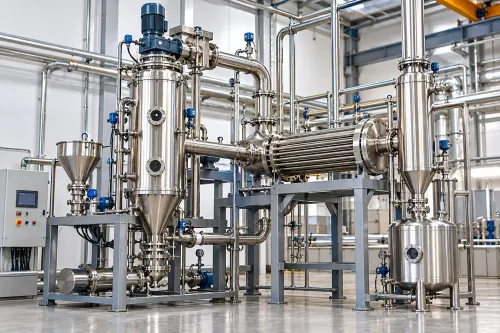
Vacuum operation suits heat-sensitive compounds and lowers boiling temperature, but only if seals hold, non-condensables are continuously removed and the condenser maintains its duty. Air leakage or weak vent condensation reduces heat transfer and capacity.
Select metallurgy from the hot concentrated liquor, not the dilute reactor feed. Corrosion assessment can lead to SS 316L, duplex steel, rubber-lined sections, nickel alloys or different gasket systems for chloride, fluoride, solvent, acidic and caustic service. Check pitting, crevice corrosion and chloride stress-corrosion cracking at hot surfaces, welds and gasket joints.
These checks matter across chemical reactors and evaporation systems in Vadodara and define reliable MEE plant chemical reactor applications.
Specifications and Compliance for a Vadodara Installation
Specify performance against a tested feed envelope, not tonnes of water evaporated per hour alone. A MEE plant for applications alongside chemical reactors in Vadodara must prove condensate quality, concentrate strength and steam use while handling campaign variability.
1. Put these values in the guarantee: flow in KLD; TDS; COD or TOC; chloride; pH; temperature; density; viscosity; steam pressure; cooling-water temperature; condensate quality; concentrate concentration; and steam consumption. State the test method, feed duration and allowable deviations.
2. Require minimum turndown, start-up time, scaling-cleaning interval, CIP or manual-cleaning procedure, interlocks for high conductivity, temperature, foam, TOC/COD, solvent or abnormal pH, and diversion capacity for off-specification batches. Define condensate reuse limits and name the authorised route for concentrate, salt or hazardous waste.
3. Check steam integration against intermittent reactor demand, pressure fluctuation, condensate-return compatibility and operation during reactor shutdowns. A steady MEE can become unstable when batch heating repeatedly starts and stops.
Tie the specification to the Gujarat Pollution Control Board consent conditions and applicable CPCB and MoEFCC requirements for hazardous-waste classification, evaporator vents, air emissions, discharge and condensate reuse. Do not infer permission from an MEE or ZLD label.
For chemical reactors and evaporation systems in Vadodara, Chemie Prozessors is relevant only if its proposal connects wastewater analysis, evaporation, drying and ZLD within one scope; test that proposal against the same envelope and guarantees.
Related products
 | ₹2300000 Providing you the best range of industrial multiple effect evaporator, multiple effect evaporators mee supplier in ankleswar, automatic mee plant,... View product → |
 | ₹2000000 Our range of products include industrial zero liquid discharge system, multiple effect evaporators mee supplier in bharuch, zero liquid discharge... View product → |
Frequently asked questions
How should a reactor discharge reach an MEE plant?
Segregate the aqueous stream at the reactor outlet, then route it to an equalization or feed tank. Use screening or filtration, oil removal, solvent separation and pH adjustment before feeding the MEE.
What feed data is needed to design an MEE for chemical reactor wastewater?
Provide flow rate, batch size and cycle pattern, feed temperature, pH, density, total dissolved solids, suspended solids, COD, chloride, sulphate, solvent content and target concentrate solids.
How do you choose an evaporator for corrosive reactor wastewater?
Compare forced-circulation, falling-film and rising-film designs against viscosity, scaling tendency, solids loading, foaming and heat sensitivity. Select wetted materials after reviewing chloride, acidity, alkalinity, solvent and temperature data.
What must be checked before commissioning an MEE installation in Vadodara?
Confirm the equipment specification, utility loads, electrical and instrumentation requirements, condensate acceptance criteria, concentrate handling route and documents required for the site and discharge permissions.
Related products
 | Evaporator ₹1500000 Product Details: Material Stainless Steel Automation Grade Automatic Usage/Application Industrial Country of Origin Made in India Multiple Effect... |
 | ₹750000 Product Details: Capacity(kg) 150 Automation Grade Automatic Usage/Application Industrial Material Stainless Steel Power Source Steam / Thermic Fluid... View product → |
 | ₹749999 Product Details: Capacity(kg) 150 Material Stainless Steel Power Source Steam / Thermic Fluid / Electric Usage/Application Industrial Country of... View product → |
Keywords