Reactor operations create more than a reaction product: they also generate mother liquor, wash water and high-TDS effluent that can overwhelm conventional wastewater handling. By following the stream from reactor discharge through evaporation, condensate recovery and solids treatment, you can decide whether an MEE fits your process and specify it without sizing the plant from averages alone.
Key takeaways
- Treat segregated reactor effluent, not the reactor batch itself.
- Base capacity on real campaign volumes, solids and boiling-point data.
- Compare steam economy against fouling risk, cleaning time and concentrate quality.
- Demand test conditions, materials and measurable performance guarantees from suppliers.
Where an MEE Fits in the Reactor Effluent Train
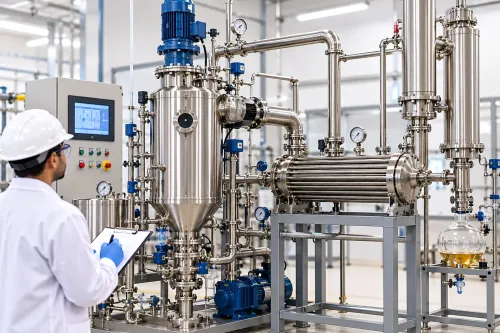
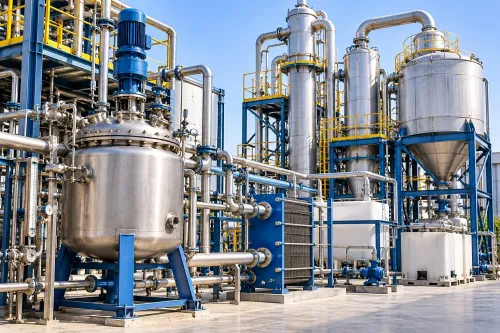
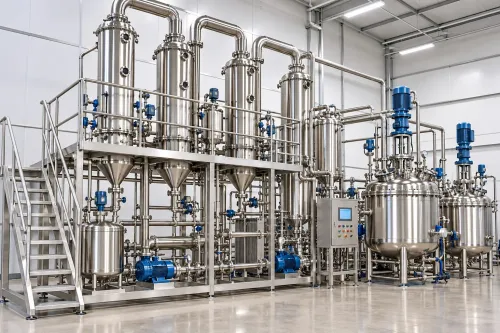
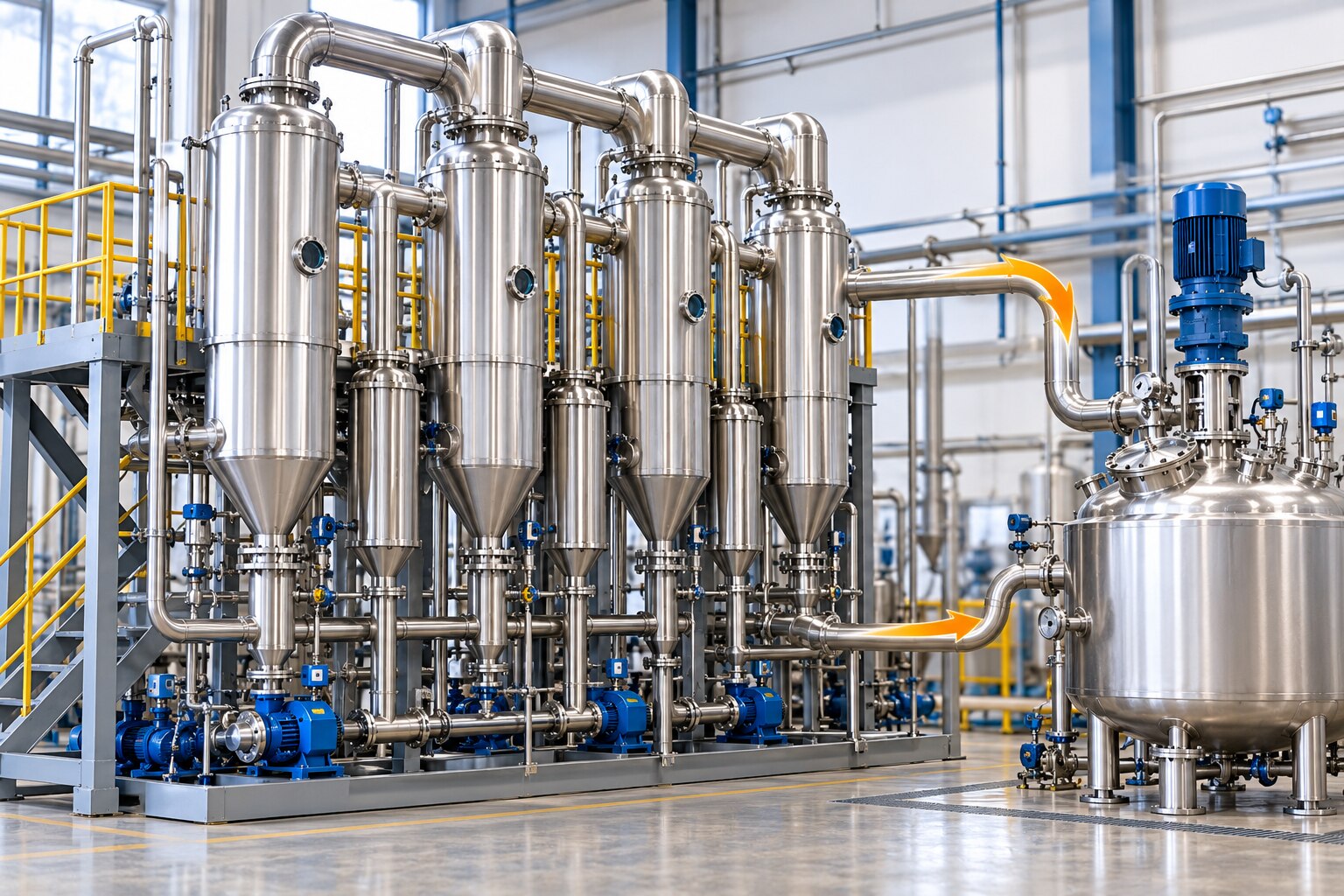
A multiple effect evaporator plant for reactors in Vadodara normally treats a downstream liquid stream, not the reactor vessel or its entire batch. Its feed is segregated reaction liquor, mother liquor, spent wash water or another high-TDS effluent selected for volume reduction, water recovery or concentrate production.
The practical flow sequence is:
- Send each compatible stream to an equalisation or feed tank. Mix batch discharges there so a continuous MEE does not receive a sudden surge in flow, TDS, solvent, temperature or viscosity.
- Screen solids and apply the needed pre-treatment: pH adjustment, filtration, settling, oil removal or chemical conditioning. Skipping this step can block pumps, foul heat-transfer surfaces or destabilise vapour separation.
- Use a feed pump to move the conditioned liquor through a preheater and into the first calandria or heat exchanger.
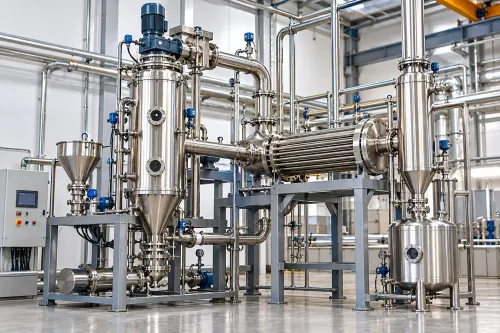
- Separate vapour from concentrated liquid in a vapour separator. Vapour supplies heat to the next effect, while liquid advances toward the final concentrate outlet.
- Collect condensate for conductivity, pH, COD or TOC, ammonia and relevant volatile-compound checks. Reuse it only against its verified specification; divert off-spec condensate from boiler, cooling-tower or process-water systems.
- Send concentrate to crystallisation, drying, recovery or an authorised disposal route.
Evaporating one reactor effluent means treating a defined side stream. Evaporating an entire batch demands tank capacity, compatibility review and equalisation before continuous feeding; the MEE is not a substitute for reactor cleaning or batch storage.
Build the Design Basis from Real Reactor Campaigns
Capacity must follow real reactor campaign profiles, not the plant’s average daily effluent. An evaporator sized for 100 m3/day can still fail when two batches discharge during a changeover and overwhelm the feed tank, pump or separator.
- Record hourly peak flow in m3/h, daily volume in m3/day, operating hours, batch size and changeover timing.
- Analyse feed and target total dissolved solids, density, viscosity, temperature, pH, suspended solids, COD, foaming tendency and boiling-point elevation.
- Measure chloride level, scaling ions, solvents and hazardous constituents, then state the required condensate quality and concentrate endpoint.
- Use these values to select heat-transfer area, pump capacity, materials and effect count; pure-water steam tables overstate capacity when salts and organics raise the boiling temperature.
Keep acidic, alkaline, solvent-bearing, high-COD, high-chloride and salt-rich streams separate. Mixing them for convenience can combine incompatible corrosion, foaming and scaling behaviour and turn a stable MEE plant for reactor operations in Vadodara into an erratic one.
For planned reuse, specify condensate limits for conductivity, pH, COD or TOC, ammonia and relevant volatile compounds. Test each stream against those limits, and divert off-spec condensate instead of sending it to boiler feed, cooling-tower makeup or process water. A daily average alone hides campaign peaks; equalisation must absorb them before continuous evaporation.
How Effects Reduce Steam Use—and Where the Trade-Offs Begin
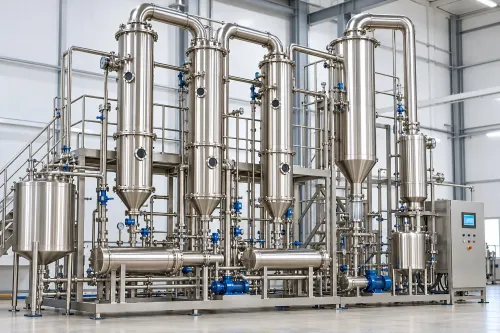
A three-effect plant reuses vapour: vapour boiled from the first effect heats the second, and vapour from the second heats the third. Vacuum lowers the boiling temperature, reducing thermal damage and steam temperature demand, but it does not remove residence-time, fouling or concentration-control risks.
A conventional three-effect arrangement indicates about 2–2.7 kg of water evaporated per kilogram of live steam. Boiling-point elevation, fouling, vent losses and feed preheating can move the result sharply. These multiple effect evaporator benefits chemical plants only when the steam saving outweighs extra heat-transfer area, vacuum equipment, controls, cleaning and maintenance.
| Option | Practical value | Main limitation |
|---|---|---|
| Single effect | Lowest capital and simpler operation | Highest live-steam use |
| RO before MEE | Removes much of the water without heat; MEE treats the smaller reject | Osmotic pressure, oil, organics and scaling limit recovery |
| Falling film | Short residence time and strong heat transfer | Needs relatively clean, low-to-moderate viscosity feed |
| Forced circulation | Handles viscous, crystallising or scaling liquor | Higher pumping power, shear and maintenance |
| Mechanical vapour recompression | Reuses compressed vapour and cuts external steam | Higher electrical load and equipment cost |
| Crystallisation | Produces solids for recovery or disposal | Adds nucleation, solids handling and cleaning duties |
| Direct hauling | Avoids evaporation equipment | Transfers cost and liability to transport and disposal |
An MEE system for chemical reactors suits high-TDS streams with steady composition and substantial water volume. Choose simpler equipment for low-TDS feed, severe foaming, heat-sensitive products, volatile solvents, highly viscous liquor, strong scaling, unstable batches, or streams better suited to solvent recovery or membranes.
Control Foaming, Scaling and the Final Concentrate
Foam can carry dissolved solids into the vapour line, contaminate condensate and destabilise level control. Provide adequate vapour disengagement, a demister and conservative vapour velocity; test antifoam compatibility with proteinaceous, surfactant-containing and high-COD feeds before approving dosing.
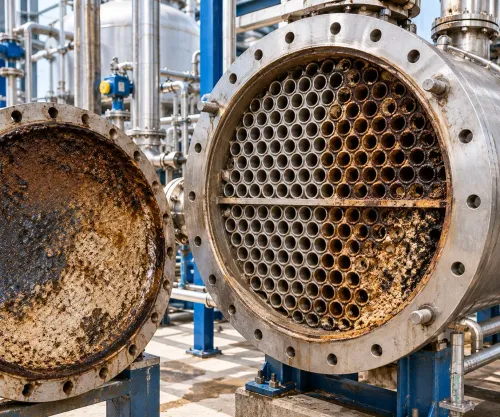
Dissolved salts and organics raise the boiling point above pure-water values. That boiling-point elevation reduces the effective temperature difference between effects, lowers capacity and increases scaling risk. A pure-water steam-table calculation can therefore overstate evaporation rate and steam economy.
When solids are expected, discharge the concentrated liquor to a solids-handling stage rather than sending near-saturated liquor across a falling-film surface.
| Option | Main purpose | Risk or requirement |
|---|---|---|
| Falling-film evaporator | Concentrate liquid with no planned solids | Rapid scaling and circulation loss near saturation |
| Forced-circulation crystalliser | Keep crystals suspended while supersaturation develops | Requires pump, abrasion review and controlled purge |
| Draft-tube-baffle crystalliser | Promote circulation and controlled crystal growth | Needs suitable residence time and solids separation |
From the crystalliser, route solids or slurry to drying, product recovery or permitted disposal. MEE does not destroy dissolved salts and does not guarantee removal of COD, colour or volatile compounds.
Test condensate for conductivity, pH, COD or TOC, ammonia where relevant, and target volatile compounds. Divert off-spec condensate; do not blend it into boiler feed, cooling-tower makeup or process water.
For concentrate and residues, check Gujarat Pollution Control Board consent conditions and classify the waste under the Hazardous and Other Wastes (Management and Transboundary Movement) Rules, 2016 before selecting recovery, transport or final disposal.
Specify Materials and Compare Supplier Guarantees
A hot, chloride-rich concentrate can pit unspecified stainless steel, trigger crevice corrosion at gaskets and cause stress-corrosion cracking at welds. For an industrial evaporation plant in Vadodara, base materials on chloride concentration, acidity, alkalinity, solvent exposure, temperature history and concentrate chemistry—not on the feed name.
Ask each supplier to document:
- Corrosion allowance, wetted parts, weld procedure qualification, gasket and seal materials
- Evaporation capacity at actual feed temperature and boiling-point elevation
- Steam consumption, condensate conductivity, pH, COD or TOC, and volatile-compound limits
- Concentrate TDS, peak hourly batch load, cleaning method, fouling assumptions and instrumentation
- Design limits for viscosity, suspended solids, vacuum, pressure and temperature
| Material | Review trigger | Main concern |
|---|---|---|
| Glass-lined steel | Strong acids, solvent-bearing liquor and moderate temperatures | Impact damage, lining inspection and nozzle repair |
| Duplex stainless steel | Chloride-bearing streams needing higher pitting resistance | Weld-zone corrosion and grade selection |
| Nickel alloy | Hot, acidic, alkaline or chloride-rich concentrate | High cost and contamination control |
| Titanium | Hot chloride service, especially where stainless steel is unsafe | Crevice design, galvanic contact and fabrication quality |
Chemie Prozessors can support a process-specific review, but the buyer must validate feed data against campaign peaks and site conditions. Require performance guarantees for capacity, steam use and condensate quality, then verify them against Gujarat Pollution Control Board consent conditions, Hazardous and Other Wastes Rules, 2016 requirements and actual disposal authorization.
Related products
 | ₹2300000 Providing you the best range of industrial multiple effect evaporator, multiple effect evaporators mee supplier in ankleswar, automatic mee plant,... View product → |
 | Evaporator ₹1500000 Product Details: Material Stainless Steel Automation Grade Automatic Usage/Application Industrial Country of Origin Made in India Multiple Effect... |
Frequently asked questions
Where does an MEE fit in a reactor effluent train?
It treats a selected downstream liquid stream such as reaction liquor, mother liquor or high-TDS wastewater after segregation and pretreatment.
What data is needed to design an MEE for reactor operations?
Use real campaign data covering flow rate, batch volume, solids, composition, temperature, viscosity, boiling point and expected concentration.
How do multiple effects reduce steam consumption?
The vapour generated in one effect heats the next effect, allowing repeated use of the same steam energy across successive boiling stages.
What operational problems must an MEE control?
Design for foaming, scaling, corrosion, viscosity rise, entrainment, cleaning access and the required final concentrate quality.
What should you compare in supplier guarantees?
Check guaranteed evaporation capacity, steam consumption, outlet concentration, condensate quality, materials, fouling assumptions and test conditions.
Related product
 | ₹2000000 Our range of products include industrial zero liquid discharge system, multiple effect evaporators mee supplier in bharuch, zero liquid discharge... View product → |
Keywords