A falling evaporation rate does not prove that the steam supply is inadequate. By comparing heat duty, temperature driving force, pressure drop, vacuum, flow and concentration, you can separate a declining heat-transfer coefficient from a utility, instrumentation or operating-condition problem.
Key takeaways
- Calculate duty and U before interpreting steam-flow changes.
- Match symptoms such as rising pressure drop to specific physical failures.
- Check feed temperature, cooling-water quality and ambient conditions in Vadodara.
- Confirm cleaning success through controlled trends in U, duty and concentration.
Start with the heat balance, not the steam-flow reading
Calculate Q = U × A × ΔTlm before interpreting steam flow. Use feed and concentrate mass flow, measured concentration, vapour rate, steam or heating-medium enthalpy, and condensate data to estimate duty. Then calculate U using the clean heat-transfer area and log mean temperature difference.
A steam-flow reading alone cannot distinguish evaporator heat exchanger performance loss from a faulty transmitter or reduced temperature driving force.
Take these readings at the same time and under steady level and feed conditions:
- Steam pressure and temperature at the exchanger inlet
- Vapour pressure and temperature, plus absolute vacuum
- Feed temperature, product temperature, flow rate, density and final concentration
- Condensate temperature, flow rate, trap discharge and shell-side differential pressure
- Process-side differential pressure and recirculation flow
A vacuum leak raises boiling pressure and boiling temperature, reducing ΔTlm even when steam pressure is normal. A transmitter error can imitate several process evaporator problems, so verify gauges against calibrated instruments before changing operating conditions.
| Diagnosis | Reading pattern | Meaning |
|---|---|---|
| Lower U | Q falls while steam and vapour temperatures preserve ΔTlm; pressure drop or viscosity rises | Deposits, poor wetting, blocked passages, non-condensable gas or condensate flooding restrict heat transfer |
| Lower ΔTlm | Steam temperature is stable, but vapour pressure or boiling temperature rises; vacuum is unstable | Air leakage, condenser limitation or inadequate steam temperature reduces the driving force |
| Both | Q and ΔTlm fall, while condensate backs up or product concentration climbs | Condensate drainage failure or rising viscosity can reduce U and available driving force together |
Match each performance symptom to its physical failure
A falling evaporation rate with normal steam pressure usually means evaporator heat transfer failure: U has fallen, part of the area is unavailable, or the log-mean temperature difference is smaller. Do not label every rising differential pressure as scale; compare it with flow, concentration, temperatures, vacuum and inspection evidence.
- Scale creates a hard insulating layer. Steam consumption rises while heat-transfer coefficient and capacity fall; confirm it with deposit thickness, hardness, and a measurable recovery after descaling.
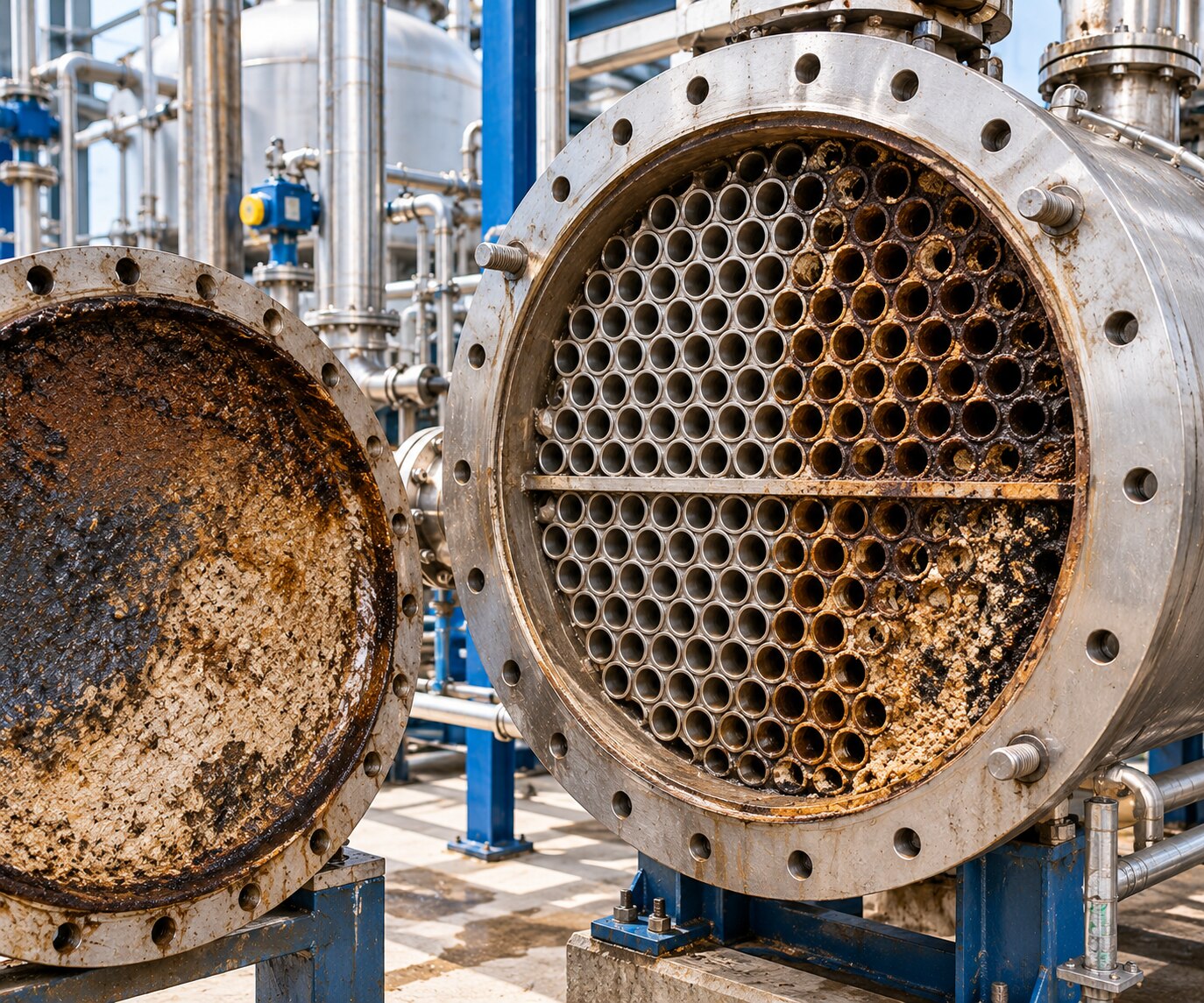
- Fouling from organics, oil, suspended solids or corrosion products produces a softer, uneven film. Rising approach temperature, darker deposits, higher viscosity or a cleaning sample distinguish it from mineral scale.
- Air or other non-condensable gas forms a barrier on the steam side. A steam temperature profile below the pressure-saturation value, unstable vacuum, or air released from vents indicates gas; inspect seals, gaskets, instrument connections and vacuum equipment.
- Condensate flooding leaves part of the heating surface submerged. Low temperature difference despite adequate steam, hot condensate, rising shell backpressure, or a failed steam trap points to blocked drainage, excessive lift or an undersized trap.
- Crystallisation narrows channels and can suddenly increase differential pressure. Rising product density, visible crystals in samples, falling circulation and a restriction at discharge or recirculation confirm it.
- Blocked passages or distributor holes cause poor flow and dry heating zones. Local wall-temperature differences, uneven wetting in a falling-film unit, and pressure loss across screens, valves or spray plates identify the restriction.
These process evaporator problems can coexist: a concentrated liquor raises viscosity, worsens wetting and accelerates crystals. Use the complete pattern rather than one pressure reading.
Vadodara conditions can change the failure mechanism
A hot-season rise in cooling-water temperature raises condenser approach temperature and weakens vacuum; monsoon changes can bring dilution, suspended solids, or altered cooling-water chemistry. For an industrial evaporator, a heat exchanger losing performance in Vadodara needs measured seasonal design data, not city averages.
- Record cooling-water inlet and outlet temperature, flow, conductivity, hardness, alkalinity, silica and chlorides across summer and monsoon conditions.
- Compare borewell, utility and wastewater sources separately; each can change carbonate scaling, silica deposition, corrosion and biological fouling risk.
- Recheck the condenser approach and vacuum after any cooling-tower, pump or water-source change.
Feed chemistry changes the deposit mechanism. Calcium carbonate, calcium sulfate, silica, magnesium salts and hydroxide deposits do not respond to the same temperature or concentration conditions. Local supersaturation at a hot wall matters more than feed TDS alone, so a small pH, temperature or recovery change can trigger rapid deposition.
Rising outlet concentration increases viscosity, thickens the liquid film and reduces circulation. In a falling-film unit, that can cause poor wetting and dry patches; in a crystallising service, solids can narrow passages and raise pressure drop. The result is evaporator heat transfer failure even with normal steam pressure.
Track feed density, final concentration, temperature, flow and solids alongside cooling conditions, then recalculate U and ΔTlm before blaming the exchanger.
Isolate the dirty side before choosing a cleaning method
Compare pressure drop, temperature profiles and samples from both circuits before opening the exchanger. A high heating-side pressure drop, cold condensate outlet or flooded shell points to steam-side restriction; a rising process-side pressure drop, falling circulation rate or solids in the liquor points to process-side fouling.
This is the core of industrial evaporator troubleshooting in Vadodara, where an evaporator heat exchanger performance loss can arise from either circuit.
- Record steam pressure and temperature at the inlet, condensate temperature and trap backpressure at the outlet.
- Record feed and liquor pressure drop, flow rate, density, concentration, vacuum and vapour temperature.
- Compare inlet-to-outlet temperature patterns, then inspect condensate, liquor and removable deposits for scale, crystals, corrosion products or biological fouling.
- Isolate and drain each side before opening; pressure-test the suspected circuit separately and inspect tubes, distributors, demisters and passages.
| Cleaning or repair | Choose it when | Damage control |
|---|---|---|
| Online rinse | Deposits are loose and water-soluble | Confirm discharge chemistry and prevent thermal shock |
| Chemical descaling | Mineral scale remains after rinsing | Match acid, inhibitor, concentration, temperature and elastomer compatibility to metallurgy |
| Mechanical cleaning | Hard deposits or blocked tubes resist chemistry | Use approved brushes or pressure; avoid tube erosion and damaged distributors |
| Tube replacement | Tubes are perforated, collapsed or wall-thinned | Verify tube material, tube-sheet fit and leak-test after installation |
Chemie Prozessors can help translate these findings into an evaporator or MEE cleaning scope, but the deposit analysis and exchanger metallurgy must control the method, not the equipment label. Never increase steam pressure to hide a restriction: it can mask the fault while accelerating corrosion, leakage or tube failure.
Related products
 | Evaporator ₹1500000 Product Details: Material Stainless Steel Automation Grade Automatic Usage/Application Industrial Country of Origin Made in India Multiple Effect... |
 | ₹2300000 Providing you the best range of industrial multiple effect evaporator, multiple effect evaporators mee supplier in ankleswar, automatic mee plant,... View product → |
Confirm recovery with controlled operating trends
Run the cleaned evaporator at a fixed feed rate, concentration, steam pressure and vacuum for several hours before judging recovery. Calculate duty and U from steam or heating-medium data, vapour pressure, temperatures and flow; compare them with the clean baseline.
A higher evaporation rate, restored U-value, lower steam consumption per kilogram of water removed and stable product concentration prove more than an outlet-temperature reading.
| Measurement | Recovery signal | Operating limit |
|---|---|---|
| Heat-transfer coefficient U | Returns to the established clean baseline at the same load | Alarm below the site-approved minimum |
| Steam economy | Returns to baseline without higher steam pressure | Investigate rising steam per kilogram evaporated |
| Heating-side and liquor-side pressure drop | Falls after deposits or blockage are removed | Stop or divert flow at the design maximum |
| Absolute vacuum and condenser approach | Vacuum remains stable; approach stays within seasonal design value | Correct leakage or insufficient cooling before raising steam pressure |
| Condensate temperature and drainage | Temperature and flow remain steady without flooding | Keep condensate outlet pressure and drain differential within design limits |
| Product carryover | Demister condensate stays clear and product loss remains controlled | Reduce vapour velocity or foam loading at the defined alarm point |
For industrial evaporator troubleshooting in Vadodara, record these trends through hot, monsoon and cooler periods because cooling-water temperature and quality change the baseline. Set feed concentration, viscosity, maximum pressure drop, minimum cooling flow and cleaning triggers from measured seasonal data. This prevents recurring process evaporator problems instead of masking them with extra steam.
Frequently asked questions
Why should you start with the heat balance instead of the steam-flow reading?
Steam flow alone does not prove evaporator duty. Use feed and concentrate mass flow, measured concentration, vapour rate, steam or heating-medium enthalpy, and condensate data to calculate Q, then calculate U from clean area and log mean temperature difference.
What physical failures cause industrial evaporator performance loss?
Fouling, scaling, non-condensable gases, poor liquid distribution, blocked passages, vacuum loss and steam-side condensate problems produce different symptoms. Compare temperature approach, pressure drop, concentration, vapour rate and heat-transfer coefficient before selecting a remedy.
How can Vadodara conditions change an evaporator failure mechanism?
High ambient temperatures affect cooling-water temperature and condenser performance, while local water chemistry can increase scaling risk. Check cooling-water inlet temperature, conductivity, hardness, silica, non-condensable removal and seasonal operating trends.
How do you confirm that cleaning restored evaporator performance?
Return the unit to comparable feed rate, concentration, steam pressure and cooling conditions. Trend duty, U, temperature approach, pressure drop, vapour rate and condensate quality, then compare stable readings with the pre-cleaning baseline.
Keywords