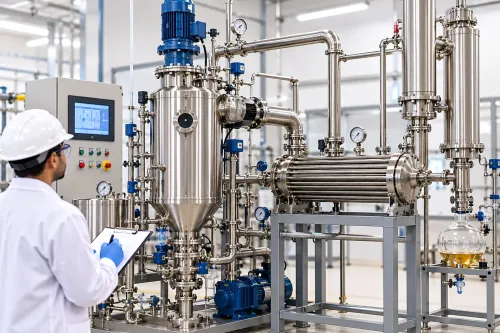
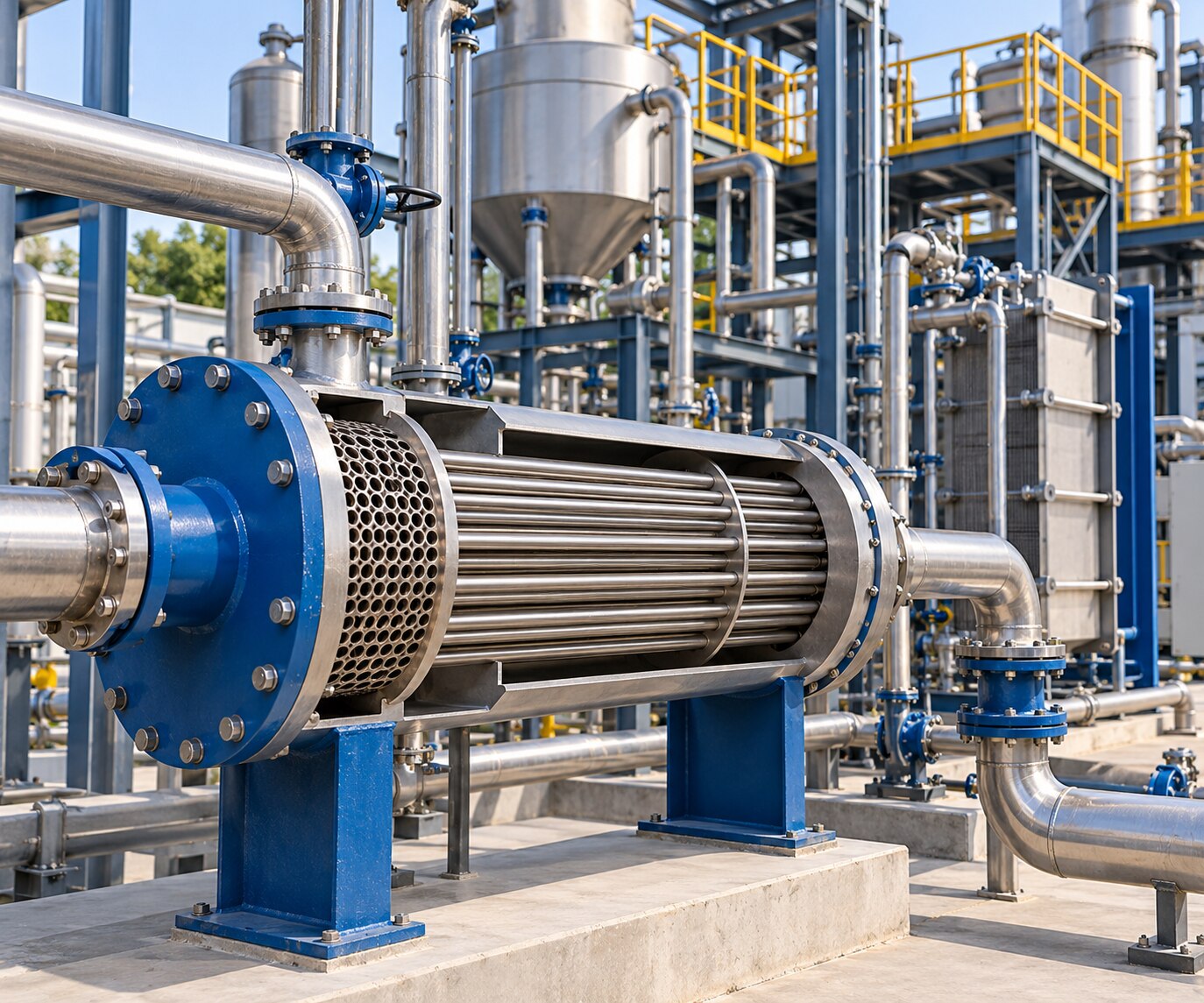
A ZLD plant moves heat between steam, vapour, condensate and increasingly concentrated wastewater without allowing those streams to mix. By the end, you will be able to trace that heat path, distinguish each heating component, and identify the operating and material data needed to select equipment for a real effluent.
Key takeaways
- Keep steam and wastewater in separate passages across a conductive metal wall.
- Place exchangers through preheating, evaporation and vapour-recompression stages.
- Choose materials and geometry around chloride, scaling, viscosity and cleaning conditions.
- Verify duty, flow, temperatures, pressure drop and condensate quality after startup.
How heat moves across a ZLD heat-transfer surface
Heat crosses a ZLD surface without the two fluids touching. Plant steam, thermocompressor steam or recompressed vapour flows through one passage, while wastewater or concentrate flows through another. A metal wall separates them; heat moves through that wall because the hot side is at a higher temperature than the boiling liquor.
Pressure sets each side’s saturation temperature. As steam condenses, it releases latent heat and leaves as condensate. The wastewater absorbs that heat and boils, producing vapour while dissolved salts remain in the liquid.
A temperature difference must exist across the wall, so zero liquid discharge heat transfer loses capacity when boiling-point elevation rises: concentrated solids make the liquor boil above the saturation temperature for its pressure.
The flow paths are straightforward:
- Hot side: steam or vapour enters, condenses on tubes or plates, and drains as condensate; non-condensable gases must be vented.
- Cold side: wastewater circulates across the metal surface, reaches its pressure-dependent boiling temperature, and sends generated vapour to a separator or the next effect.
| Name | What it identifies | Typical duty |
|---|---|---|
| Heat exchanger | Indirect transfer across a separating surface | Any hot-to-cold energy transfer |
| Evaporator | Removal of water by boiling | Concentrating wastewater |
| Condenser | Vapour changed to liquid | Recovering vapour heat |
| Heater or reboiler | Heating or boiling process duty | Raising liquor temperature or vapourising it |
| Steam chest | Enclosed steam space around heating surfaces | Supplying condensing steam to an evaporator |
An industrial heat exchanger for ZLD may therefore sit inside an evaporator, reboiler or steam chest. The name describes the arrangement or duty; the exchanger describes how heat is transferred.
Where exchangers sit in the Vadodara ZLD process
1. A ZLD system process in Vadodara starts with equalisation and clarification: screens, pH adjustment, coagulation, flocculation and settling remove suspended matter before the feed reaches biological or physicochemical treatment where organics, nutrients, metals or specific contaminants require it. A feed preheater can recover heat from hot condensate or concentrate before reverse osmosis.
2. RO recovers relatively clean permeate, but its reject carries rising osmotic pressure and dissolved solids. Further RO recovery then demands excessive pressure and gives poor water yield, so reject moves to evaporation. Feed-feed exchangers, shell-and-tube heaters or tube-bundle heaters raise its temperature before the MEE train.
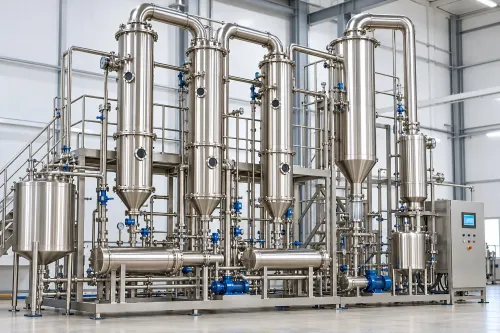
3. In multiple-effect evaporation, a calandria (sometimes called a calendria) or tube bundle boils liquor on each effect. Vapour from one effect condenses on the heating side of the next effect, which operates at lower pressure; vacuum lowers boiling temperature and preserves the temperature driving force.
Inter-effect vapour condensers, condensate coolers and hot-concentrate recovery reduce steam demand.
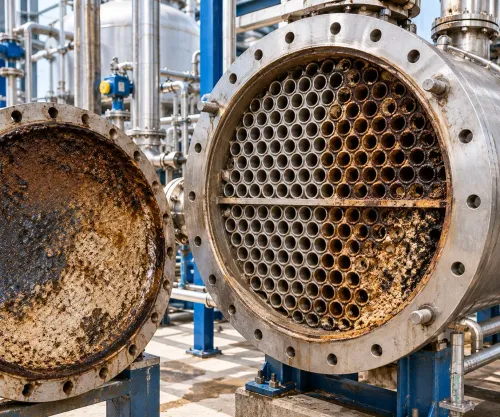
4. As liquor thickens, boiling-point elevation and scaling from calcium sulfate, calcium carbonate, silica or mixed chloride-sulfate deposits reduce exchanger performance. The train may send concentrated liquor to crystallisation, a forced-circulation slurry concentrator or directly to an ATFD, where a heated tube bundle or thin-film surface dries it.
5. The final solids route includes centrifuges, filter presses or vacuum filters, followed by salt collection, storage, recovery or off-site disposal. The exact order changes with chloride, sulfate, silica, hardness, organics and consent conditions; condensate quality and odor control also determine whether recovered water can return to the process.
Which exchanger configuration survives concentrated liquor
Choose the exchanger by solids loading and viscosity, not by heat-transfer area alone. A zld heat exchanger in vadodara that handles clean RO permeate or condensate has different limits from one boiling chloride-rich slurry.
| Configuration | Best fit | What makes it fail |
|---|---|---|
| Shell-and-tube or plate | Clean feed preheating and condensate service; counter-current passes maximise temperature recovery | Calcium carbonate, calcium sulfate, silica, gasket attack, or chloride corrosion |
| Forced-circulation heater | Viscous, high-solids liquor; high liquor circulation suppresses deposition | Pump power, blocked tubes, scale carried into the loop, and excessive residence time |
| Falling-film or rising-film surface | Short residence time and efficient area use; falling film suits clean, well-distributed feed | Poor distributor wetting creates dry patches; foaming causes entrainment and unstable film flow |
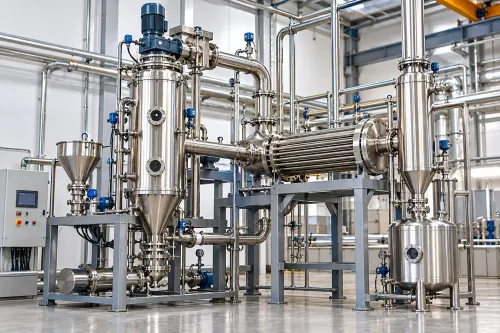
| Calandria or short-tube evaporator | MEE effects with vapour heating and robust tube bundles | Mixed chloride-sulfate scale raises pressure drop and demands frequent cleaning |
| Scraped or agitated thin-film surface | Concentrated slurry and final drying | Broken scraper clearance, abrasive crystals, foaming, or feed too thick to spread |
Run steam or recompressed vapour on the heating side, with condensate draining continuously and non-condensables vented from the steam chest. Route liquor co-currently or counter-currently according to temperature approach, then recirculate it fast enough to keep tubes wetted and vapour separate through a demister.
Falling-film distribution must remain even; dry patches overheat metal, while foaming and entrainment contaminate vapour and condensate. Calcium sulfate, calcium carbonate, silica and mixed chloride-sulfate deposits can make any nominally suitable arrangement fail.
What to specify before buying a ZLD heat exchanger
A heat exchanger in a zero liquid discharge system in Vadodara must be sized from the concentrated liquor, not clean water. Clean-water heat-transfer coefficients ignore rising viscosity, changing boiling-point elevation, suspended solids and fouling resistance, producing too little area and unstable evaporation.
Send the vendor:
- Feed flow in KLD, required evaporation duty, inlet and outlet temperatures, operating and design pressure, vacuum level, and available steam or thermic-fluid pressure and temperature.
- TDS, chloride, sulfate, silica, hardness, pH, organics and suspended solids at feed, concentrate and maximum operating concentration.
- Viscosity across that concentration range, boiling-point elevation, scaling tendency, circulation rate, expected foaming, and the cleaning chemicals, temperature and access available.
| Materials selection | Specify and check | Failure risk |
|---|---|---|
| Stainless steel | Grade against concentrate chloride, temperature, acid and caustic excursions | Pitting, stress corrosion or rapid wall loss |
| Gaskets and welds | Chemical compatibility, gasket elastomer, weld procedure, passivation and inspection records | Leaks, crevice attack and contamination |
| Tubes and surfaces | Tube-wall thickness, weld quality, crevice exposure and removable or cleanable geometry | Erosion, plugged passages and unreachable scale |
Review higher alloys or non-metallic linings when chloride, low pH, oxidants, hot caustic cleaning or tight crevices exceed the selected stainless grade’s corrosion margin. Chemie Prozessors can assess this duty as part of an evaporation, drying or ZLD train rather than as an isolated utility item.
Related products
 | ₹2000000 Our range of products include industrial zero liquid discharge system, multiple effect evaporators mee supplier in bharuch, zero liquid discharge... View product → |
 | Evaporator ₹1500000 Product Details: Material Stainless Steel Automation Grade Automatic Usage/Application Industrial Country of Origin Made in India Multiple Effect... |
How to verify performance after commissioning
Record a commissioning baseline before judging an industrial heat exchanger for ZLD: calculate heat duty from measured flow, inlet and outlet temperatures, and utility enthalpy, then trend:
- Feed and utility flow, temperature, pressure and vacuum
- Condensate rate and quality
- Evaporation rate and liquor concentration
- Heat-transfer temperature approach
- Differential pressure across each side
A rising temperature approach means fouling, poor distribution or falling circulation. Evaporation falling while utility input stays constant points to scale, boiling-point elevation or feed changes. Rising differential pressure indicates blockage or deposits; unstable vacuum indicates air ingress, leaking seals, insufficient condenser capacity or non-condensables.
Inspect demisters and vapour separators for damage and liquid carryover. Test condensate for conductivity, volatile organics, ammonia and hydrogen sulfide before reuse as boiler feed, cooling-tower makeup or process water. Foaming and entrainment contaminate condensate even when exchanger temperatures look normal.
| Heating method | Main advantage | Main risk to verify |
|---|---|---|
| Live steam | Low electrical demand; straightforward control | Higher steam consumption; vacuum and non-condensable losses reduce duty |
| Mechanical vapour recompression | Reuses vapour and reduces external steam demand | Higher electrical demand; compressor damage from liquid carryover |
| Mechanical vapour recompression | Efficient at stable conditions | Sensitive to foaming, entrainment and non-condensables |
A zld system process in Vadodara is successful only when concentrated brine becomes crystallizer solids, filter cake or recoverable salt, with defined handling and disposal criteria. Include cleaning chemicals, odor control and salt storage in acceptance tests; zero liquid discharge alone does not prove complete ZLD performance.
Frequently asked questions
How does heat transfer occur in a ZLD heat exchanger?
Steam or recompressed vapour flows through one passage while wastewater or concentrate flows through another. A metal wall separates the fluids, and heat moves from the hotter stream into the boiling liquor.
Where does a heat exchanger sit in a Vadodara ZLD process?
Exchangers can preheat incoming wastewater, transfer heat within evaporator effects, condense vapour and support crystallizer duty. Their position depends on the plant’s evaporation and vapour-recompression arrangement.
Which heat exchanger configuration suits concentrated ZLD liquor?
Select the configuration after checking liquor viscosity, chloride concentration, scaling tendency, solids loading, cleaning method and allowable pressure drop. Tube, plate and scraped-surface designs each impose different fouling and maintenance trade-offs.
What should you verify after commissioning a ZLD heat exchanger?
Record hot- and cold-side flow, inlet and outlet temperatures, operating pressures, pressure drop, steam consumption and condensate quality. Compare the measured heat duty with the design duty and inspect early fouling indicators.
Related product
 | ₹2300000 Providing you the best range of industrial multiple effect evaporator, multiple effect evaporators mee supplier in ankleswar, automatic mee plant,... View product → |
Keywords