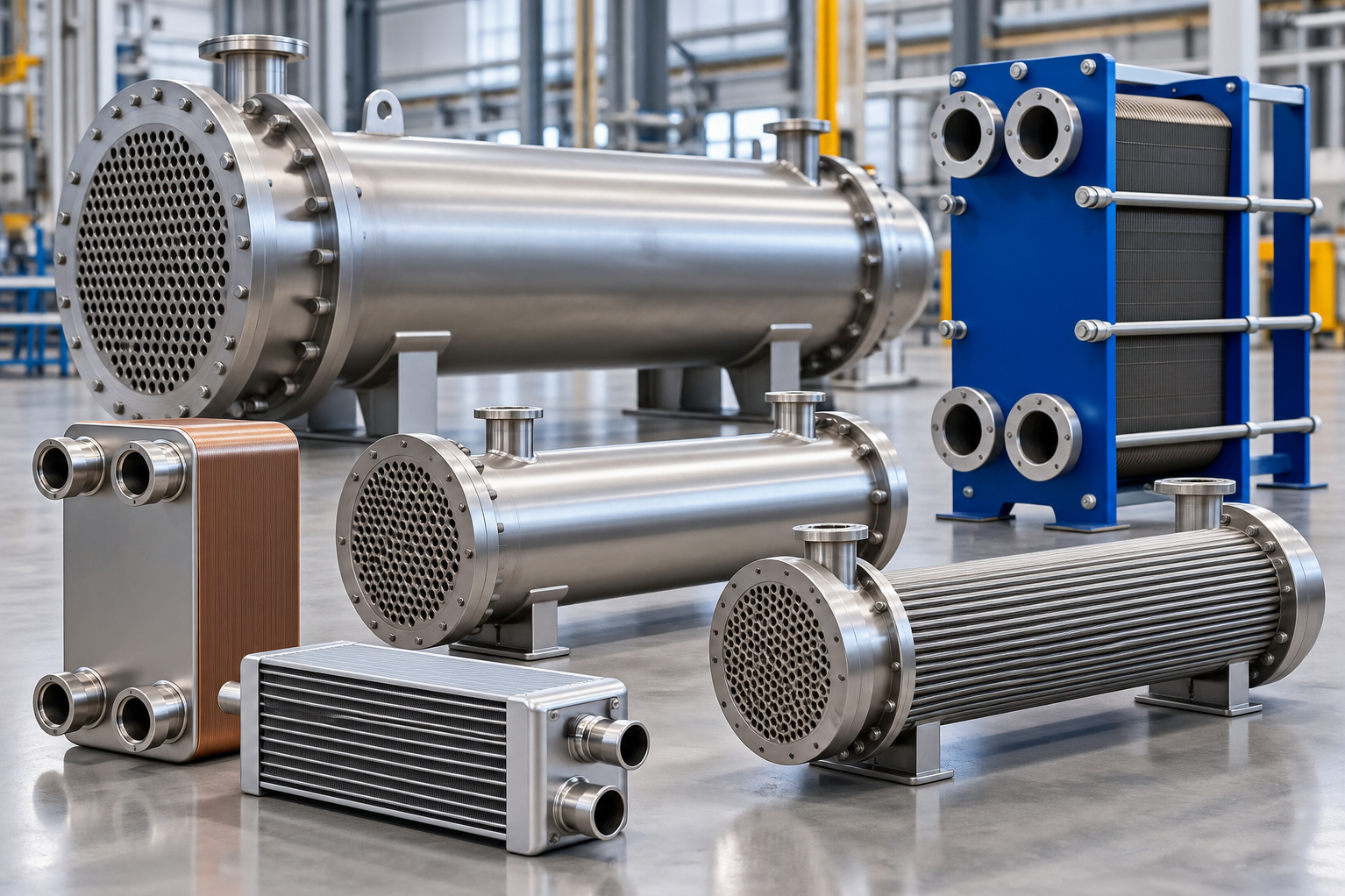
Heat exchangers appear throughout process plants, transferring energy between steam, water, oil, refrigerant, solvent and product streams. Although their function seems straightforward, incorrect thermal data or mechanical assumptions can create inadequate heating, excessive pressure drop, fouling and unplanned shutdowns.
A structured technical review helps procurement teams select a heat exchanger manufacturer in Vadodara with confidence.
Start With Complete Process Conditions
The manufacturer needs information for both the hot and cold sides. This includes inlet and outlet temperatures, flow rates, operating pressures, allowable pressure drop and physical properties.
Density, viscosity, thermal conductivity and specific heat may change with temperature. For condensing or boiling service, vapour composition, latent heat and non-condensable gas content are also important.
Normal, minimum and maximum cases should be provided. A unit sized for the design maximum may perform poorly at very low flow unless turndown is considered.
Choose the Appropriate Exchanger Type
Shell-and-tube exchangers are widely used because they can accommodate many pressure, temperature and material combinations. They can also be configured for removable bundles or mechanical cleaning.
Plate heat exchangers offer compact construction and close temperature approaches for suitable clean-liquid duties. Spiral, finned-tube and other specialised designs may serve fouling, gas or compact-installation requirements.
Selection should consider more than thermal area. Maintenance access, leakage risk, gasket compatibility and future duty changes can influence lifecycle value.
Understand Fouling Allowance
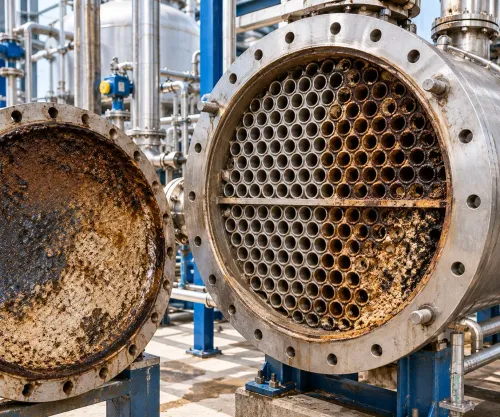
Deposits on heat-transfer surfaces create resistance and reduce performance. Fouling may result from scaling, polymerisation, suspended solids, biological growth or thermal degradation.
A fouling allowance provides additional surface area, but excessive allowance is not always beneficial. Oversizing can reduce velocity, encourage further deposition and increase cost.
The manufacturer should evaluate fluid velocity, wall temperature and cleaning method together. If mechanical cleaning is planned, tube layout and bundle accessibility must support it.
Review Pressure Drop
Higher velocity can improve heat transfer and limit deposition, but it also increases pressure drop and pumping cost. Excessive velocity may cause erosion or vibration.
The proposal should state calculated pressure drop for both streams. Piping losses, control valves, and elevation changes should be considered separately in the wider system design.
For vapour service, pressure drop can alter condensing temperature or vacuum performance and should receive particular attention.
Check Mechanical Design Details
Thermal expansion can create stress when the shell and tubes operate at different temperatures. Fixed-tube-sheet, U-tube and floating-head arrangements manage this issue differently.
Mechanical evaluation should cover:
- Design pressure and temperature
- Applicable design code
- Corrosion allowance
- Tube and shell materials
- Gasket and bolting specifications
- Nozzle loads
- Expansion provisions
- Supports and lifting lugs
- Vent and drain connections
- Insulation requirements
If the exchanger operates under vacuum, external-pressure design must be included.
Verify Inspection and Testing
A suitable quality plan may require material certificates, welding-procedure records, welder qualifications, non-destructive examination and pressure testing.
Tube-to-tube-sheet joints deserve careful inspection because leakage can contaminate the process or utility stream. Depending on service, tests may include hydrostatic testing, pneumatic testing, helium leak testing or dye penetrant examination.
All testing requirements should be agreed before fabrication begins.
Plan for Installation and Maintenance
The layout must provide space for bundle removal, head opening and tube cleaning. An exchanger that fits the operating footprint may still be unmaintainable if access is inadequate.
The enquiry should show preferred nozzle orientation, foundation conditions and nearby obstructions. Lifting arrangements and removable spool pieces can simplify future maintenance.
Working With a Vadodara Manufacturer
Vadodara’s proximity to chemical, pharmaceutical and engineering clusters across Gujarat makes it a practical base for process-equipment coordination. Chemie Prozessors can evaluate heat-transfer duty alongside connected reactors, evaporators, condensers and utility systems.
Before ordering from a heat exchanger manufacturer in Vadodara, compare thermal calculations, construction details, inspection scope, and maintainability. A well-specified exchanger should achieve the required temperatures without imposing excessive pressure drop or creating avoidable cleaning difficulties.
Keywords